Conductive Silicone Rubber Keypad Push Button
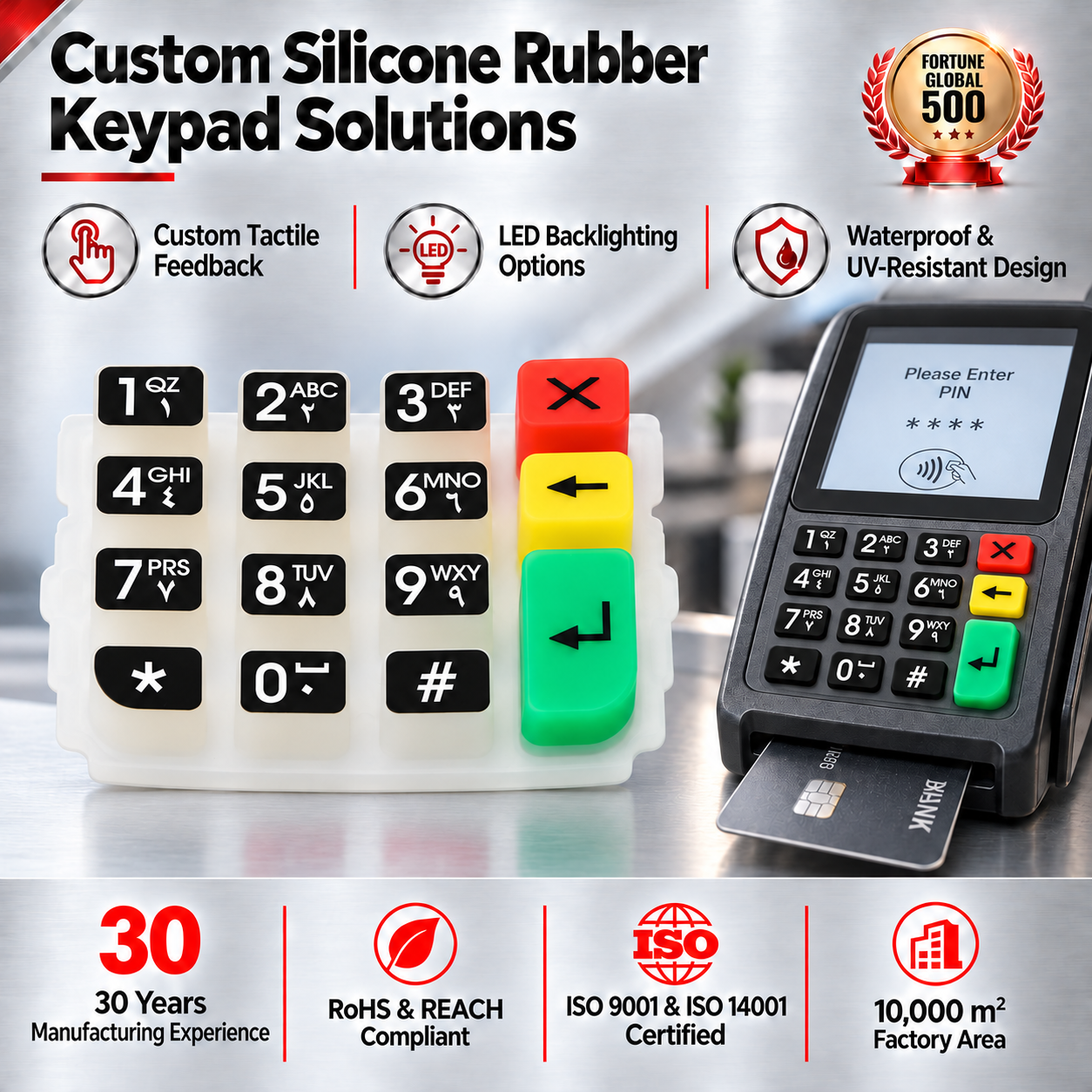
Low-resistance carbon pill elastomer pad engineered for medical monitoring hardware, high-cycle diagnostics, and chemical-resistant cleanroom equipment.
Tailored capacitive switching, conductive silicone, and environmental seal assemblies engineered specifically for automated machinery, medical consoles, and specialized apparatus across North Rhine-Westphalia.
Low-resistance carbon pill elastomer pad engineered for medical monitoring hardware, high-cycle diagnostics, and chemical-resistant cleanroom equipment.
Integrated surface-mount micro-LED windows paired with high-snap tactile stainless domes, ideal for commercial HVAC and smart appliance consoles.
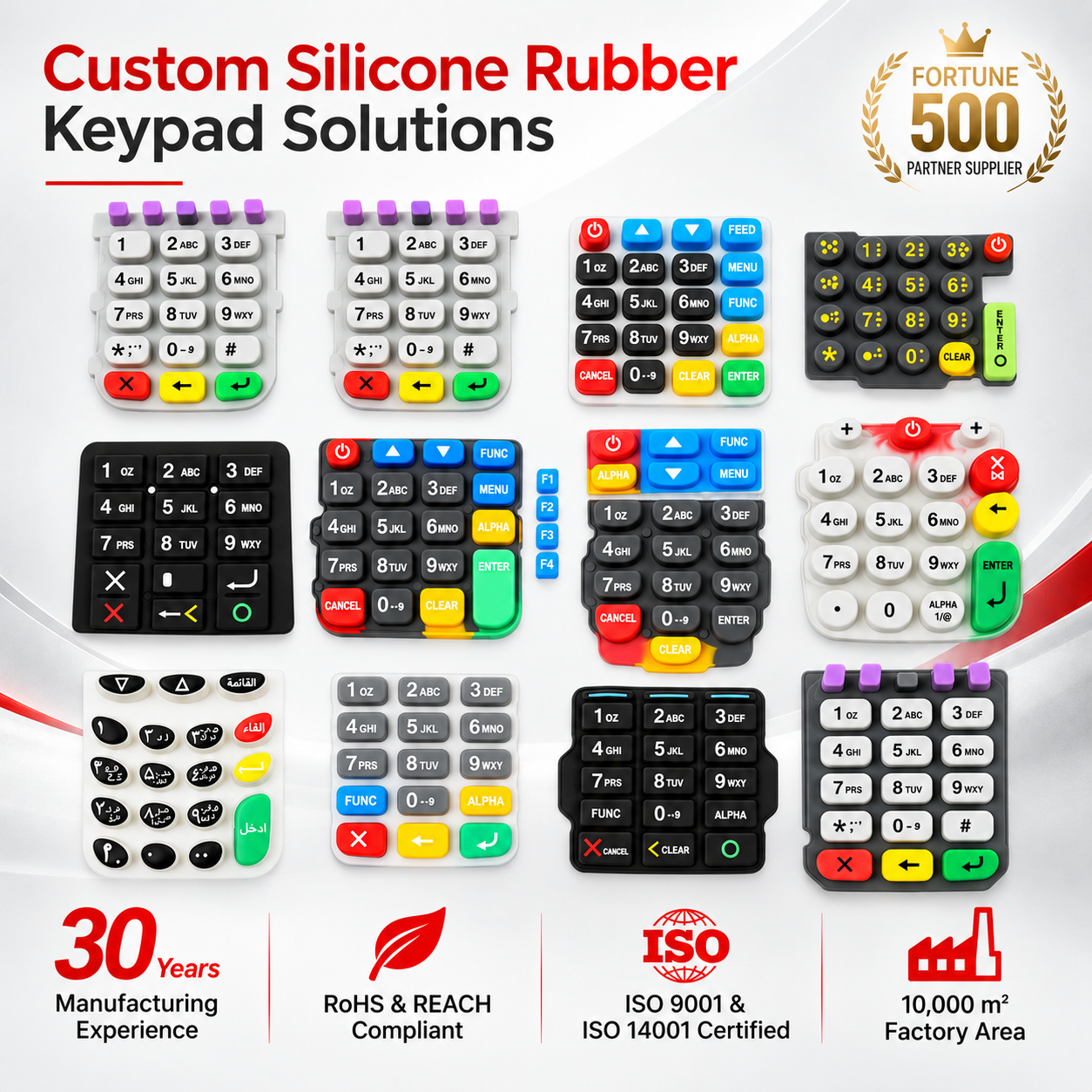
Ultra-durable, weather-sealed elastomeric rubber switches with wear-resistant legends formulated for logistics, fleet control, and automotive telematics.
High-durability plastic-on-rubber hybrid keypad providing true tactile feedback and scratch-proof hardtops for secure access nodes and weighing terminals.
Embossed actuation surfaces with stable low-impedance carbon printing, designed for laboratory heating gear, culinary hardware, and industrial controllers.
Laser-etched light guides and translucent silicone composition allowing uniform illumination across mission-critical communications gear and server interfaces.
Harsh-environment resistive and tactile hybrid pad built with gas-fume sealing and UV-stabilized PET, certified for outdoor petrol kiosks and public terminals.
High-elasticity silicone strip featuring progressive force curves and gold-plated PCB contact options, designed for premium audio equipment and instrumentation.
Modern capacitive touch switches (Kapazitive Tastschalter) have transitioned from consumer-grade novelties into the de facto standard for rigorous industrial Human-Machine Interfaces (HMI). For OEM manufacturers and mechanical engineering hubs located in the greater Düsseldorf metropolitan area—anchored by chemical processing plants, specialized automation engineering (Sondermaschinenbau), and state-of-the-art medical technology clusters—the mechanical switch presents fundamental physical limitations.
Traditional electromechanical switches feature dynamic seams, exposed internal metal springs, and elastomeric seals prone to degradation when repeatedly exposed to industrial solvents, CIP (Clean-in-Place) chemicals, and wash-down detergents. In contrast, solid-state capacitive switching systems utilize projected capacitive sensing (PCAP) or surface capacitive electrodes printed directly onto sub-surface PET or copper Flexible Printed Circuits (FPC).
By shifting mechanical deflection to dielectric charge perturbation sensing, OEMs obtain a wear-free actuation surface that completely isolates internal electronics from dust, moisture, corrosive gases, and volatile industrial compounds. This architecture represents the baseline for the next generation of Industry 4.0 smart factory control nodes deployed throughout Western Germany.
| Engineering Parameter | Capacitive Touch Front | Tactile Dome Membrane |
|---|---|---|
| Physical Wear Lifecycle | Solid-State (>100M Touches) | 1.0M - 5.0M Mechanical Domes |
| Ingress Protection Potential | IP68 / IP69K Continuous | IP65 - IP67 Sealed Perimeter |
| Cover Plate Substrates | Tempered Glass, PMMA, Polycarbonate | Embossed PET / Autotex Film |
| Glove Operation Feasibility | Tuned firmware (<5mm Nitrile/Leather) | Universal Mechanical Snap |
| EMC / Noise Immunity (IEC 61000-4-6) | Requires Active Driven Shielding Layer | Inherent Shield Layer Integration |
Customizing dielectric properties, cover materials, and multi-protocol interfaces for the specialized engineering requirements of North Rhine-Westphalia's industrial ecosystems.
Centering around the world-renowned MEDICA exhibitions and surrounding healthcare diagnostic labs, local device creators demand front interfaces resistant to quaternary ammonium disinfectants, isopropyl alcohol, and high-pressure steam cleaning. Our tempered glass capacitive switch panels offer completely seamless coplanar surfaces preventing microbial bio-film buildup while maintaining fine touch sensitivity through clinical nitrile gloves.
The Rhine-Ruhr corridor represents Germany's manufacturing nucleus, featuring heavy stamping machines, tube-bending apparatus, and blast-furnace telemetry. We deploy customized capacitive sensors equipped with integrated active grounding shields and ferrite suppression traces, preventing electromagnetic interference (EMI) induced by three-phase high-voltage variable-frequency drives (VFDs) and electrical discharge machining lines.
Serving automated public transit hubs, canal freight lock automation along the Rhine River, and fast-growing electric vehicle (EV) charging stations, our panels integrate optical bonding with hydrophobic overlay coatings. These capacitive switch matrices eliminate condensation traps and feature built-in baseline tracking firmware that auto-calibrates against heavy rain droplets, frost, and extreme ambient temperature shifts from -40°C to +85°C.
As German engineering pivots aggressively toward the dual goals of decentralized digitalization (Industrie 4.0) and sustainable product lifecycle mandates (EU Ecodesign Regulations), capacitive touch switches are undergoing rapid technological reconfiguration:
A key drawback historically cited by German machinery operators was the absence of physical tactile confirmation when using a flat touch surface. Next-generation assemblies now merge capacitive sensor matrices with localized linear resonant actuators (LRAs) and piezoelectric disc drivers. When a virtual button threshold is crossed, the panel discharges an ultra-low latency mechanical impulse (120–250 Hz) giving the operator definitive tactile confirmation even while wearing heavy industrial leather safety gloves.
By fusing capacitive silver ink circuit paths into thermoformed plastic films prior to high-pressure injection molding, assemblies eliminate bulky mechanical chassis. This 3D curved structural integration enables bespoke aerodynamic dashboard control surfaces, reduces component part counts by up to 60%, and complies directly with German weight-reduction roadmaps for transportation machinery.
Under CE, RED, and the updated EN 61000-6-2/4 standards, electromagnetic compatibility compliance is scrutinized heavily during customs clearance and commissioning audits in Germany. AXRU integrates multi-layer mesh shielding, guard traces, and advanced charge-transfer IC firmware to secure zero false-triggering in dense RF environments. Concurrently, our Dongguan plant works with bio-based PET film substrates and recyclable acrylics to help our European partners fulfill upcoming Corporate Sustainability Due Diligence Directive (CSDDD) transparency metrics.
Eliminate intermediary broker markups and engineering miscommunications. Dongguan AXRU Electronics Co., Ltd. provides a vertically integrated 10,000㎡ manufacturing environment audited and verified on-site by Intertek.
From Class 1,000 automatic silk-screen printing to copper FPC circuit routing, laser micro-machining, and hot-press lamination, all critical operations remain in-house under strict ISO 9001:2015 quality protocols.
Our lab houses automated Force-Displacement Profilers, programmable Temperature & Humidity Chambers (-50°C to +150°C), UV Yellowing Testers, and Taber Ink Decolorization stations for exhaustive design verification.
Bridge the technical divide. Our project engineers evaluate your DXF, DWG, STEP, or Gerber files directly for Design for Manufacturability (DFM), verifying connector pitch, pinout impedance, and dielectric spacing before tooling.
Key considerations on logistics, European Union regulatory compliance, minimum order tiers, and rapid prototyping workflows.
Whether you require a rapid proof-of-concept prototype, an ingress-sealed capacitive array for a medical console, or a high-volume manufacturing partner with Intertek-verified credentials, our engineering department is standing by.
Inquire Now