10,000㎡
Cleanroom Facility
12+ Yrs
Precision HMI Engineering
100%
Optical & Circuit Tested
100 Pcs
Agile OEM Prototype MOQ
Engineering Architectural Foundations: Flexible Printed Circuits (FPC) vs. Screened Silver Ink
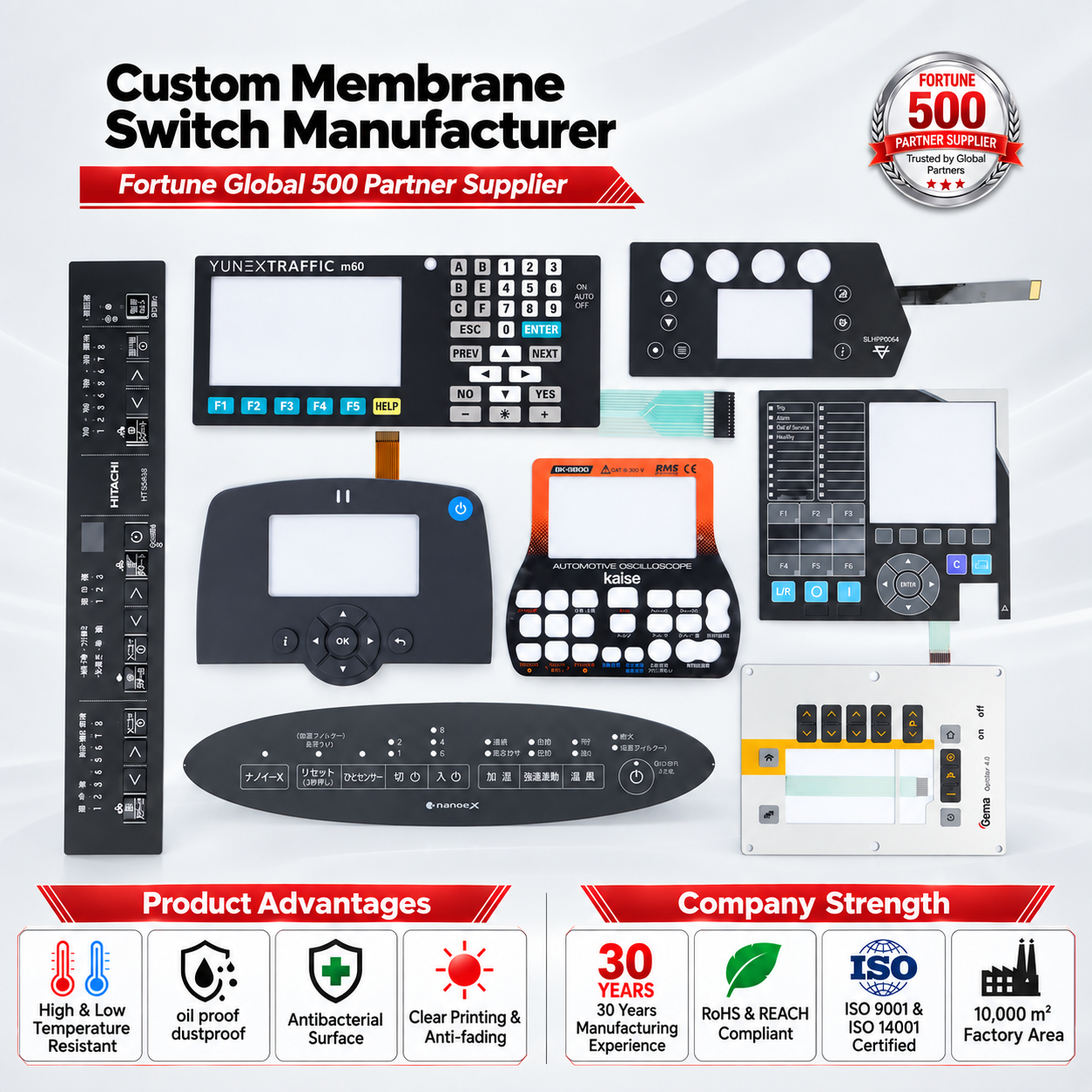
Within high-performance industrial equipment, the structural integrity of the internal switching layer dictates the device’s lifecycle operational safety. Traditional membrane keyboards rely heavily on screen-printed conductive silver ink deposited onto Polyethylene Terephthalate (PET) films. While economical for basic indoor consumer interfaces, silver-printed substrates remain inherently vulnerable to silver migration under persistent direct current biases when deployed in high-humidity or thermally fluctuating environments—a failure mechanism that results in dendritic growth, short circuits, and unrecoverable HMI failures.
For demanding procurement requirements in Luxembourg, particularly across the automated logistics facilities, metallurgy operations, and clean manufacturing ecosystems surrounding Dudelange, Flexible Printed Circuit (FPC) membrane switches represent the definitive technological standard. Built upon rolled annealed or electro-deposited copper traces laminated to ductile polyimide (PI) dielectrics, FPC substrates deliver an operational impedance typically below 0.1 Ω/sq—vastly superior to silver ink's 10–25 Ω/sq. This ultra-low trace resistance enables the direct surface mounting (SMD) of micro-controllers, miniature status LEDs, zener diodes for ESD mitigation up to 15kV, and ultra-fine-pitch zero-insertion-force (ZIF) tails without the interfacial contact fractures common to flexed PET silver tails.
| Physical & Electrical Parameter |
Standard Silver-Inked PET Substrate |
Copper-Polyimide FPC Substrate (AXRU Standard) |
| Conductor Loop Resistance |
20 Ω – 100 Ω (variable with tail trace length) |
< 0.5 Ω – 2 Ω (ultra-low signal degradation) |
| Component Soldering Capabilities |
Conductive epoxy bonding only (fragile shear limit) |
Reflow soldering & hot-bar thermo-compression compatible |
| Tail Pitch Tolerances |
Standard 1.0mm to 2.54mm pitch |
Ultra-dense 0.5mm, 0.3mm micro-ZIF integration |
| Flexural Endurance (MIT Test) |
Approx. 10,000 cycles at R=2mm bend radius |
> 250,000 dynamic cycles with zero trace separation |
| Operating Thermal Range |
-20°C to +65°C |
-40°C to +125°C continuous thermal duty |
Localized Industrial Integration: Application Scenarios Across Dudelange & Southern Luxembourg
The southern territory of Luxembourg, historically established upon blast furnace infrastructure and steel transformation, has structurally transitioned into a high-technology industrial node. Anchored by the Eurohub Sud multimodal logistics hub and specialized heavy-engineering manufacturing centers in Dudelange, the requirements for Human-Machine Interfaces extend far beyond standard commercial durability.
1. Multimodal Freight Automation & Cold-Chain Telematics: Located at the nexus of major European rail freight corridors, Eurohub Sud relies heavily on container-handling gantry cranes, rail-to-road swap-body automation, and sub-zero cold-storage warehousing. Keypads installed on mobile vehicle terminals and handheld scanners face constant condensing moisture, mechanical vibration, and temperature swings between -25°C storage zones and ambient outdoor air. Our IP67 perimeter-sealed FPC keypads with fluorosilicone overlays provide complete ingress protection, preventing micro-condensation from inducing false contact triggering.
2. Heavy Processing, Metallurgy & Robotics Enclosures: Dudelange’s remaining specialized metallurgy lines, coil treatment operations, and automated fabrication facilities demand interfaces resistant to hydraulic fluid exposure, airborne particulate contamination, and harsh cleaning agents. We utilize textured Autotex® polyester and reverse-screened chemical-barrier inks coupled with four-legged stainless steel tactile metal domes (actuation forces from 280g to 450g), assuring crisp tactile feedback through heavy work gloves while standing up to industrial degreasers.
3. Clean Industrial Testing & Medical Diagnostic Instrumentation: Luxembourg’s expanding health-tech and precision metrology clusters necessitate HMI panels that maintain a sterile boundary. Our PMMA acrylic front panels and reverse-printed graphic overlays feature anti-microbial coatings and dead-front visual display windows, permitting daily wipedowns with quaternary ammonium or 70% isopropanol solutions without clouding or surface degradation.
Strategic Industrial Trends Shaping Input Interface Procurement in Luxembourg
System integrators, mechanical designers, and contract manufacturers operating across the Greater Region (Luxembourg, Lorraine, Saarland, Wallonia) are experiencing a profound technological convergence in control ergonomics. Four fundamental procurement vectors currently drive HMI development in the Dudelange market:
• Migration Toward Hybrid Sensory Interfaces: Pure capacitive touch screens often fail when operators wear dielectric-insulating gloves or work in rain-exposed logistics docks. The emerging market preference in southern Luxembourg focuses on hybrid control surfaces: combining capacitive sliders for rapid parameter navigation with tactile, embossed FPC metal-dome buttons for safety-critical inputs (Emergency Stops, Pump Engage, System Reset).
• Strict Adherence to European REACH and RoHS Standards: Dudelange manufacturers export directly across the European Single Market. Sub-tier supplier compliance is scrutinized heavily. AXRU guarantees that all polyimides, silicone elastomers, conductive adhesives, and double-sided bonding films (3M 200MP series, 300LSE for low-surface-energy plastics) strictly comply with the latest EU REACH SVHC lists and RoHS Directive 2011/65/EU.
• High-Reliability Backlighting for Low-Light Multi-Shift Logistics: Round-the-clock transshipment terminals require clear nighttime visibility without operator eye strain. By embedding high-efficiency side-firing micro-LEDs within thin light-guide films (LGF) positioned directly beneath the FPC layer, we achieve uniform legend luminance across the entire front fascia using less than 15mA current draw, reducing battery drain on mobile industrial terminals.
AXRU Electronics Manufacturing Capabilities: Intertek-Verified Global OEM Standards
With an operational footprint exceeding 10,000 square meters in Dongguan, China, and an engineering corps of over 120 specialized personnel, Dongguan AXRU Electronics Co., Ltd. serves as a primary tier manufacturer for Fortune 500 industrial entities and European OEMs. Unlike trading intermediaries, we control every critical phase of fabrication under unified ISO-aligned cleanroom environments:
• In-House Cleanroom Printing & Laser Die-Cutting: Precision automated screen-printing benches, high-speed multi-axis CNC digital routing, and flatbed die-cutting ensure our graphic overlays achieve positional tolerances within ±0.05mm, eliminating bezel misalignment on cast aluminum or injection-molded chassis.
• Integrated Metrology & Reliability Testing Laboratory: We avoid third-party testing delays by verifying environmental and functional compliance in-house. Our facility houses dedicated key life cycle test benches (exceeding 5,000,000 actuations), automatic force-displacement curve plotters for tactile feel consistency, UV yellowing accelerated aging chambers, and programmable temperature/humidity chambers (-40°C to +150°C).
• Agile Engineering Prototyping (MOQ 100 Pieces): Recognizing that bespoke industrial machinery and specialized European automation runs do not always warrant massive unit volumes, AXRU supports Dudelange design houses with low minimum order quantities (from 100 units), providing full DFM (Design for Manufacturability) engineering reviews, layer stack-up CAD drawings, and Pantone color swatches before hard tooling is released.