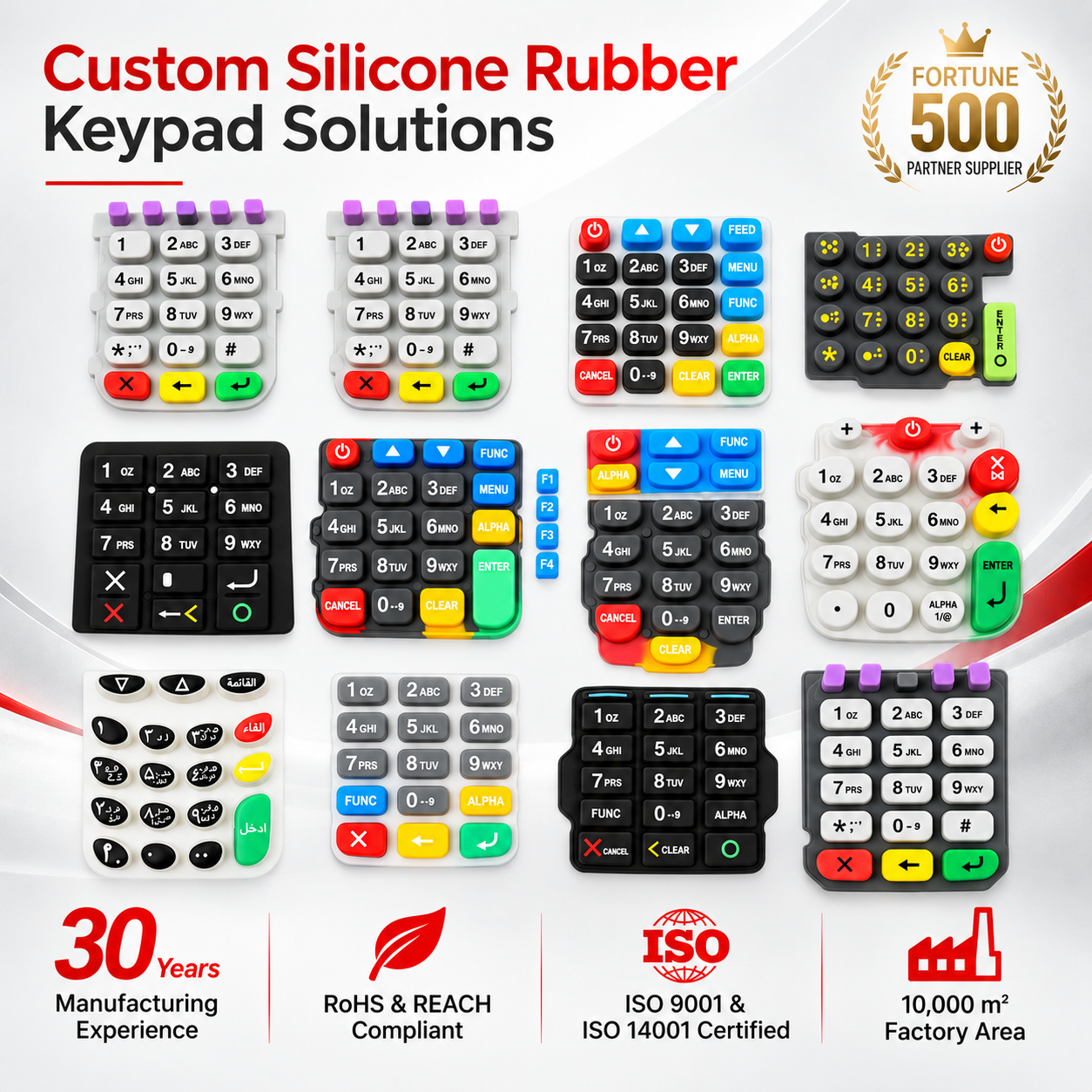
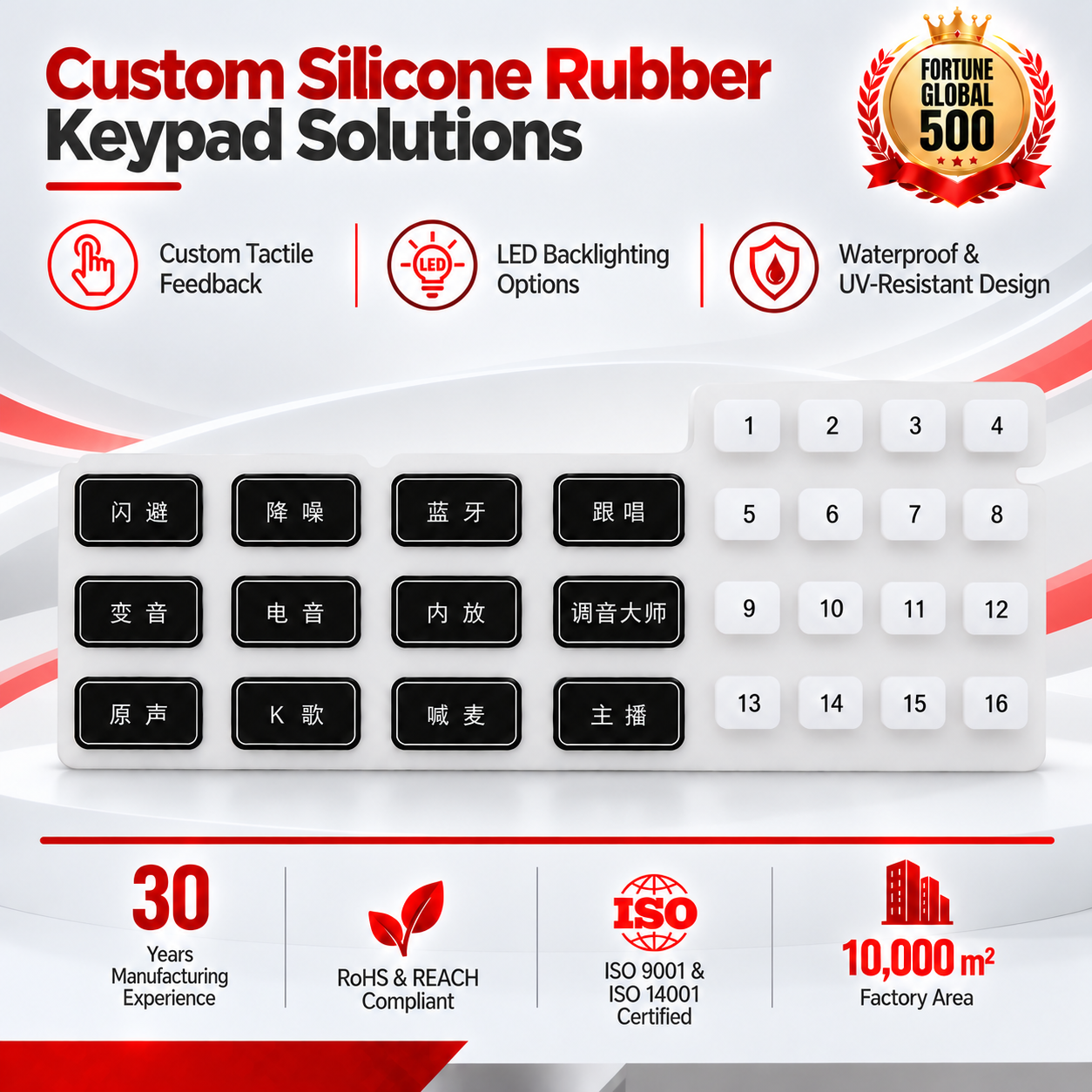
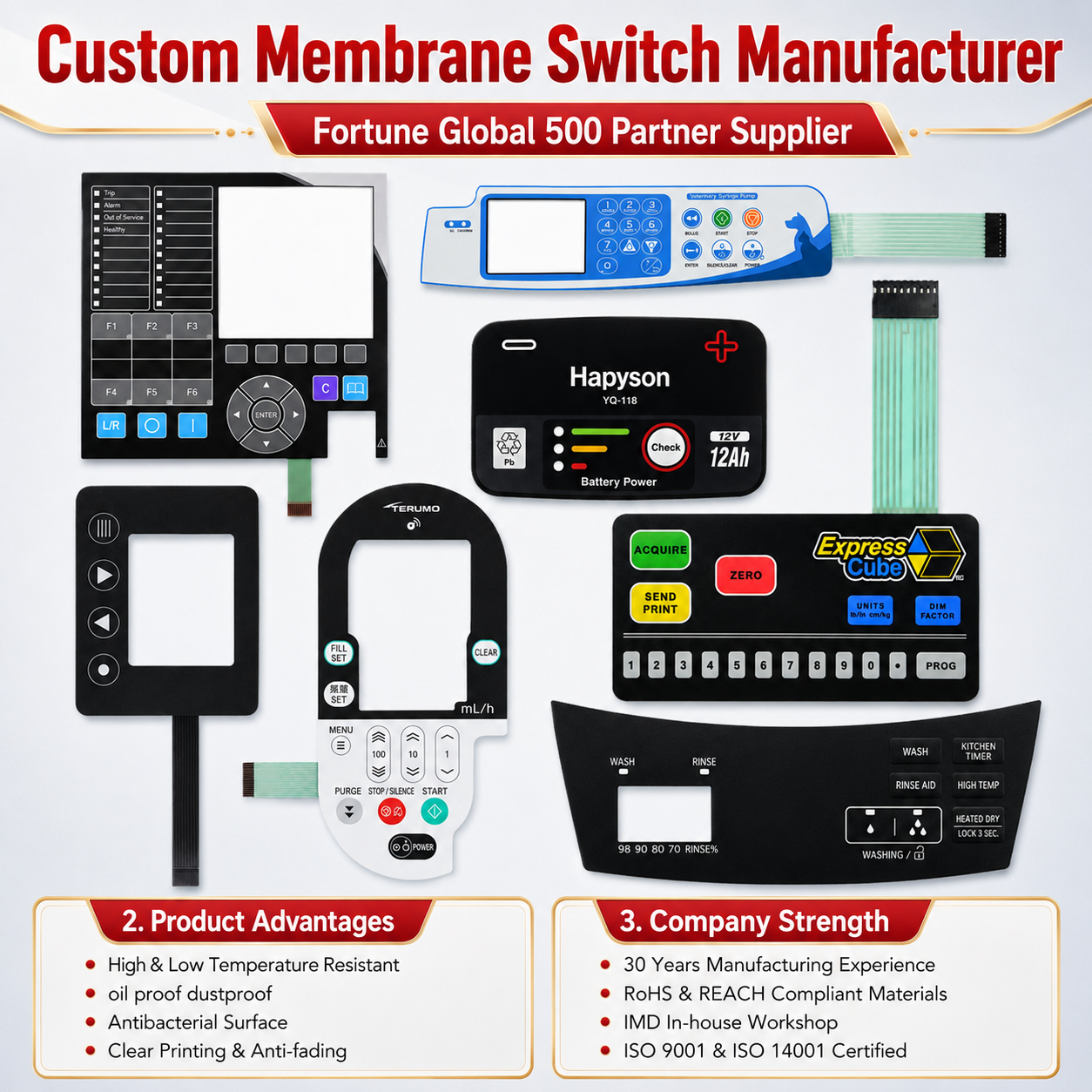
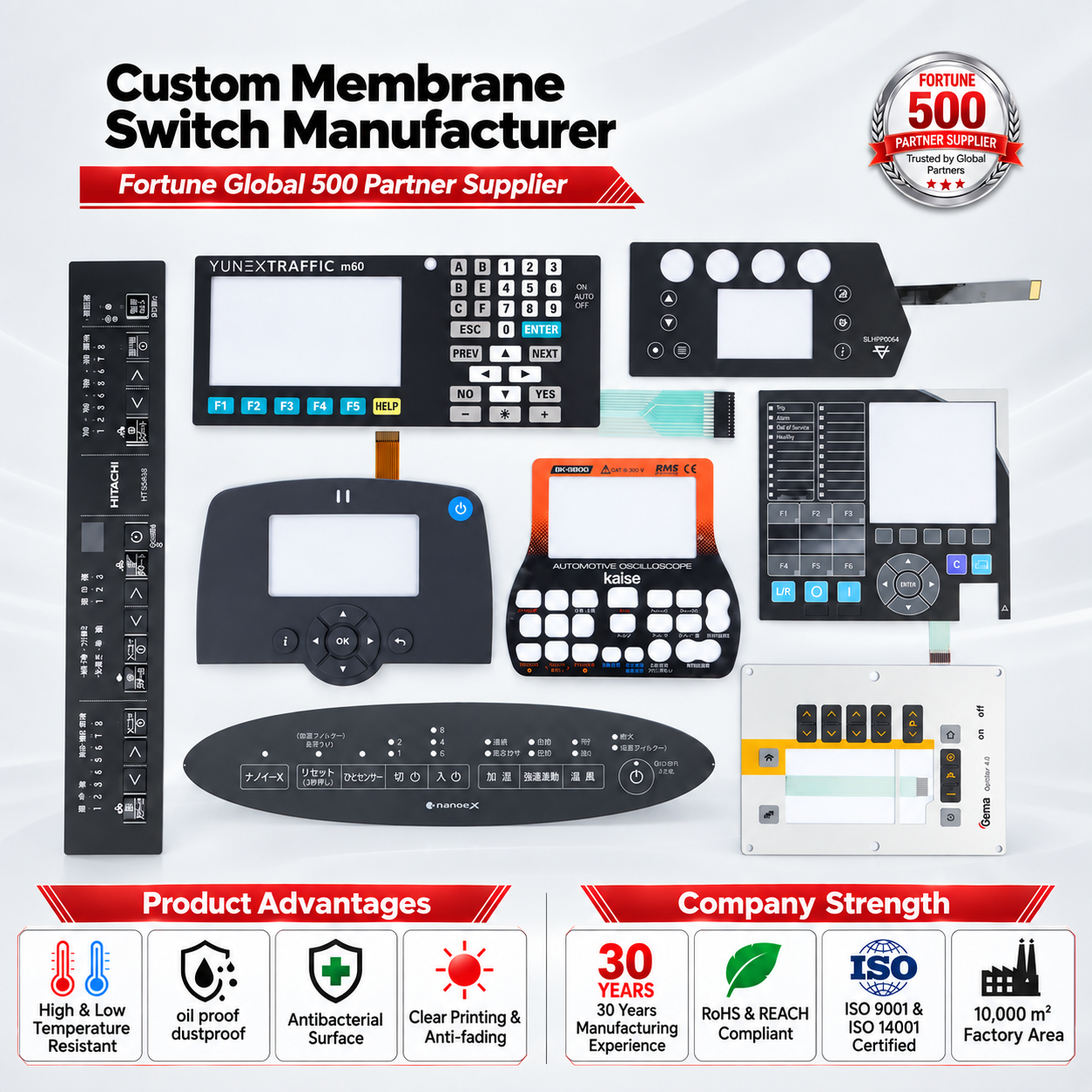
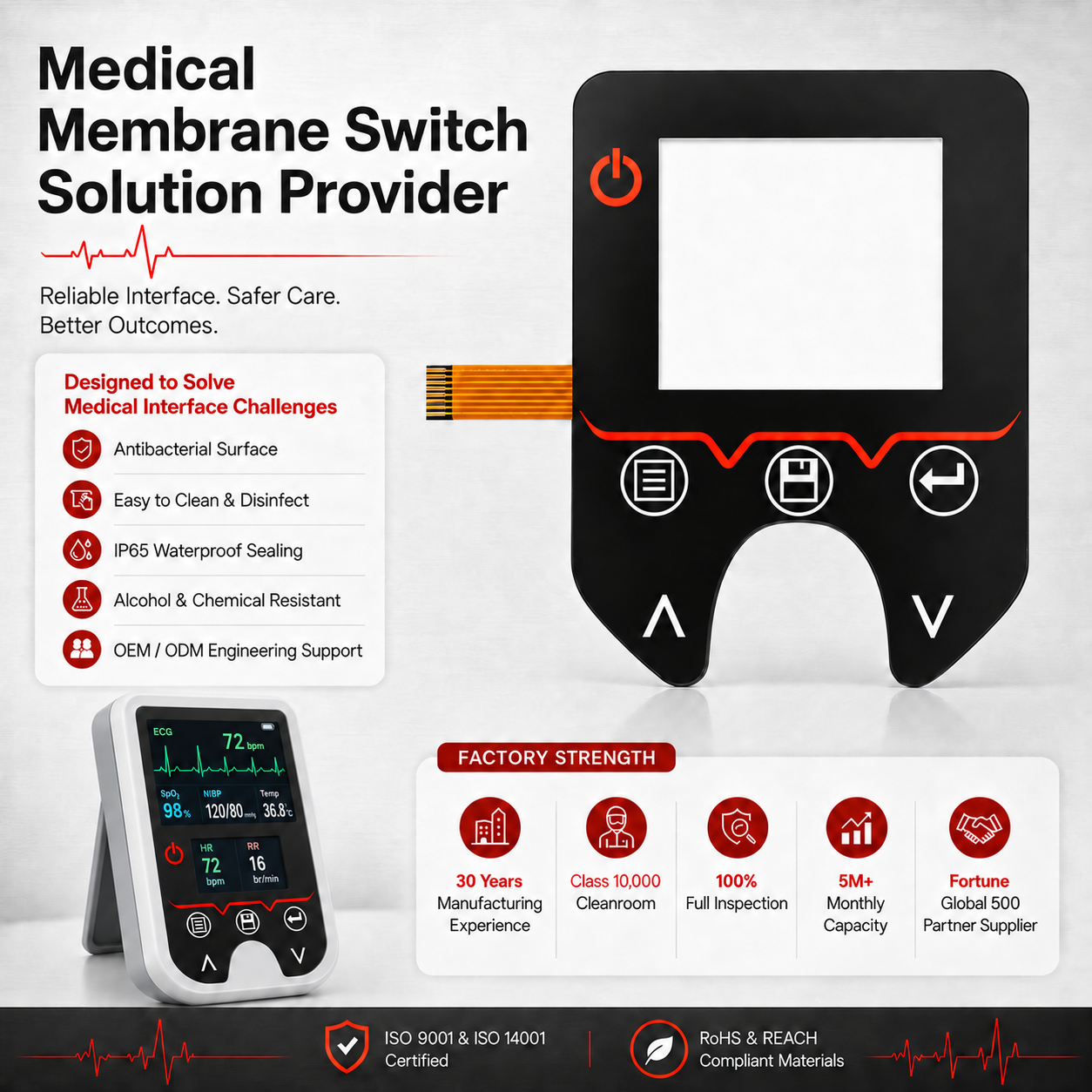
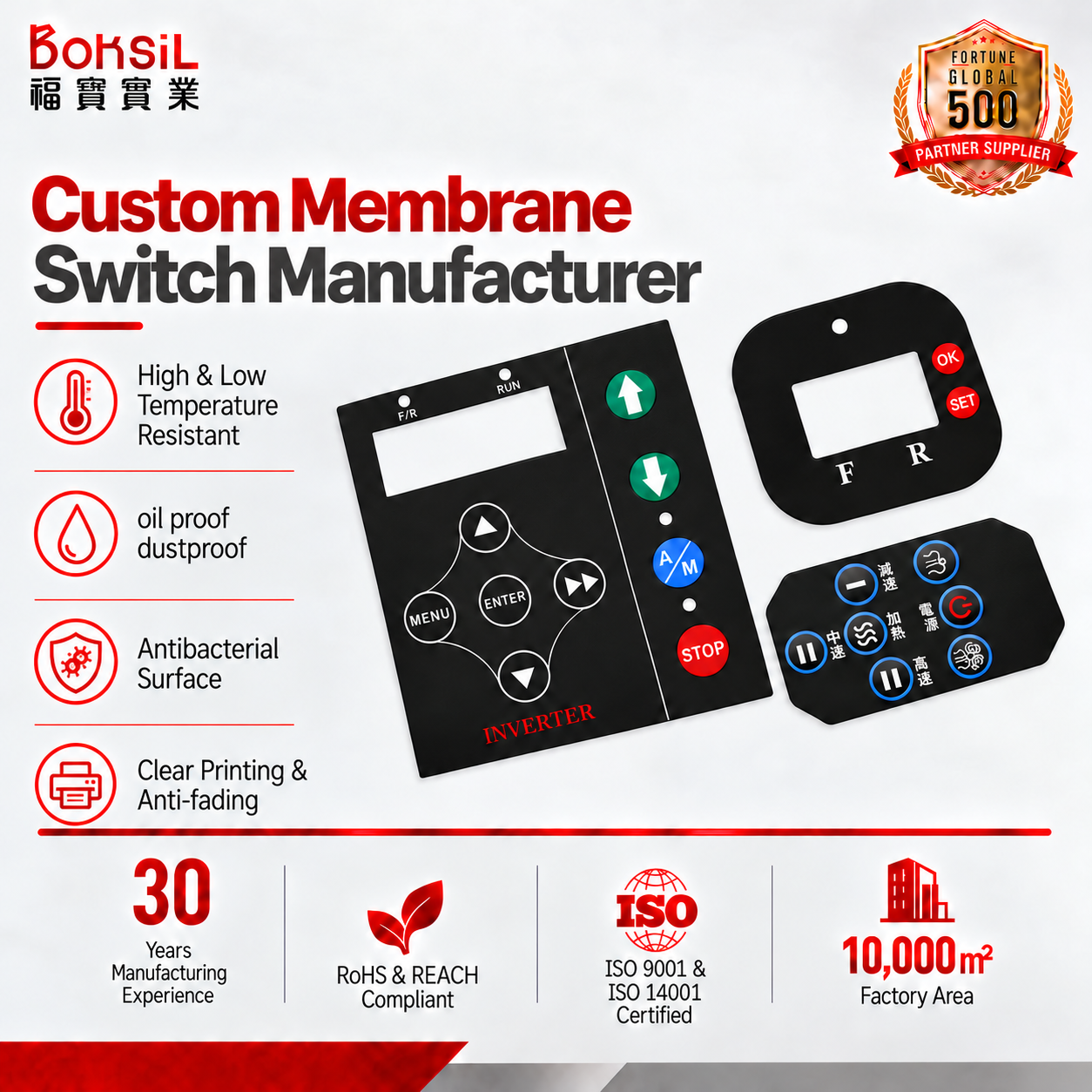
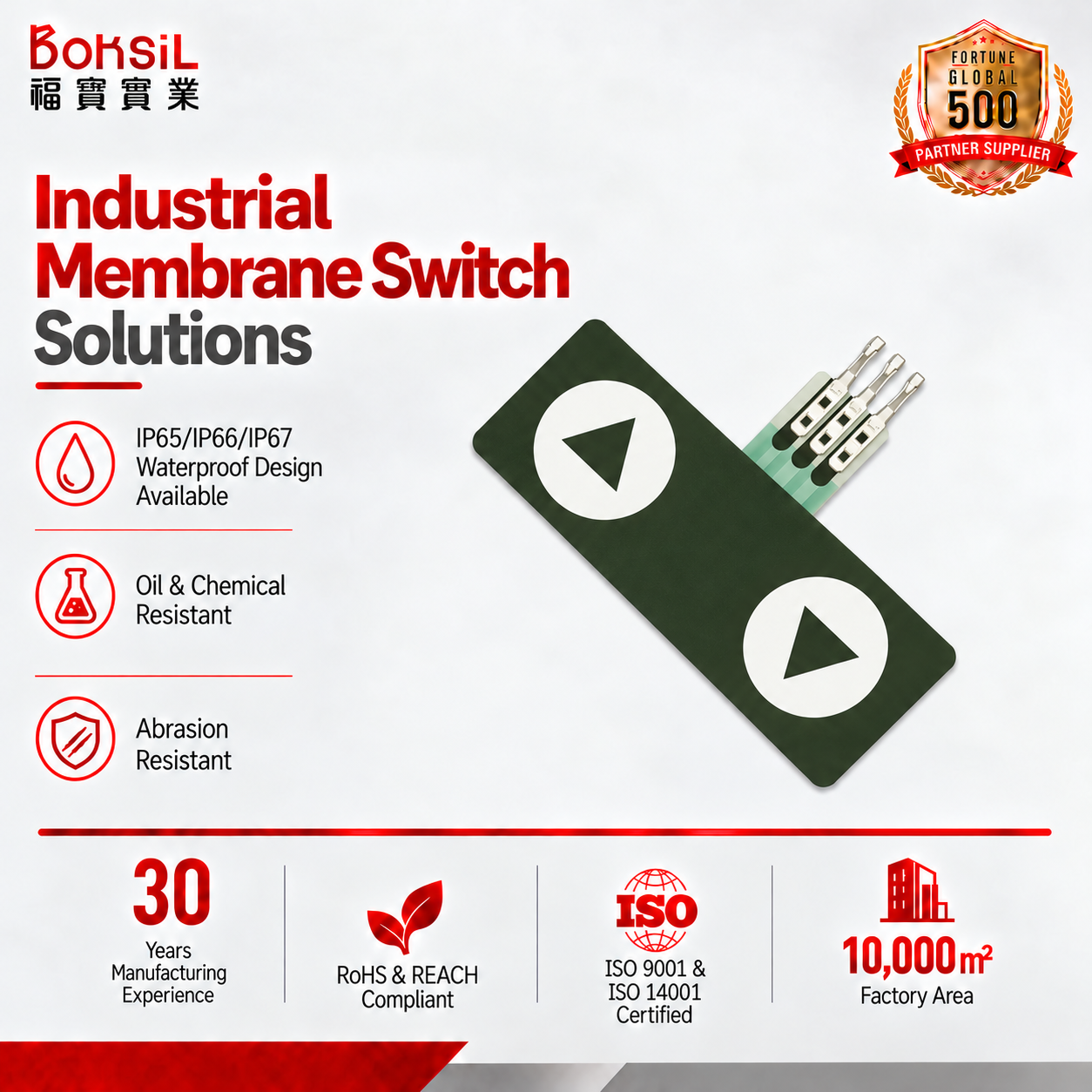
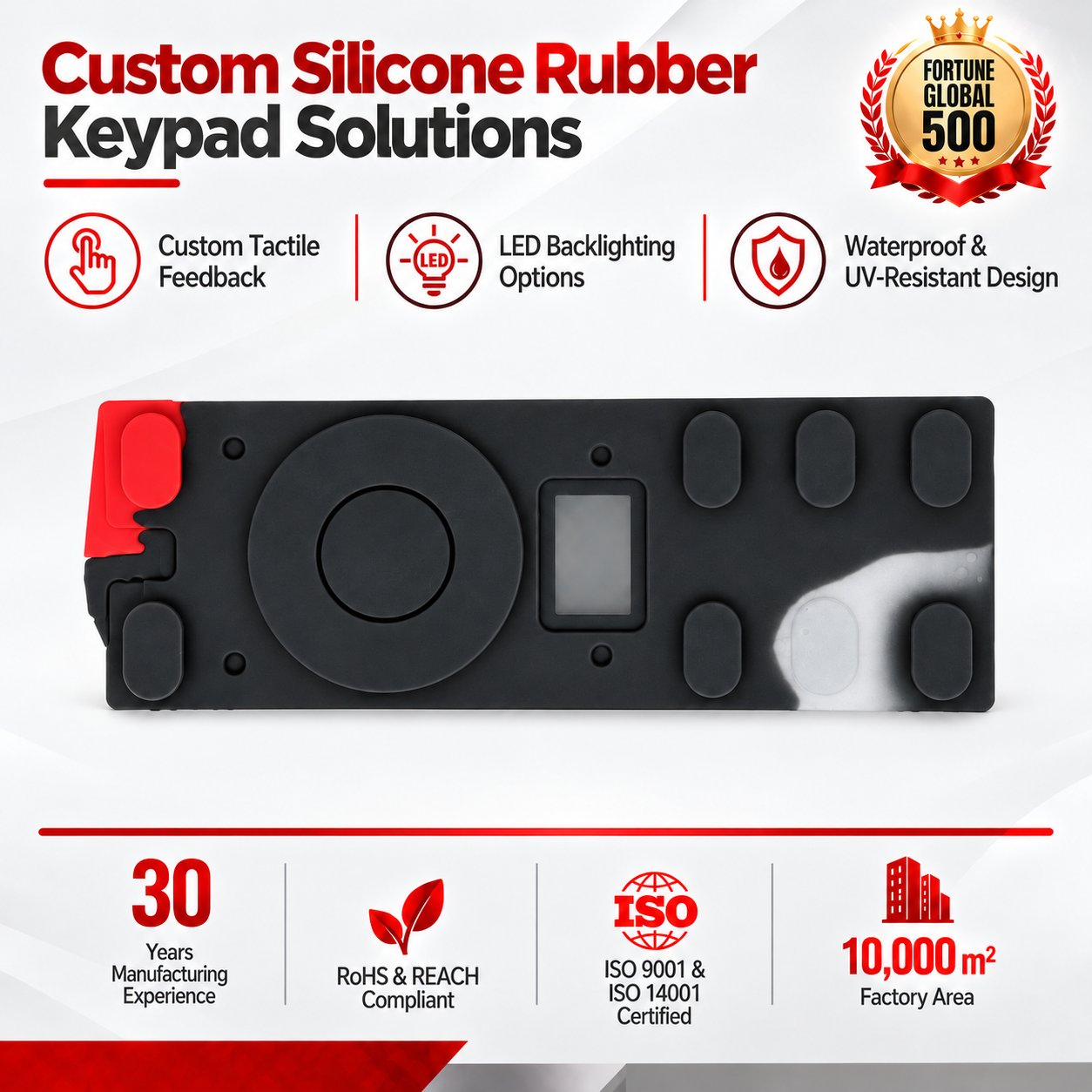
Customizable Design Black Embossed Circular Buttons Red Silicone Rubber Keypad Panel Switch for Industrial Control
- Substrate Layer: Conductive Silicone
- Sealing Grade: IP65 Equivalent
- Actuation Life: >1,000,000 Cycles
Engineered for extreme operating environments across medical equipment, robotics, automotive dashboards, and harsh industrial environments. Explore our top OEM/ODM assemblies.
Unlike trading brokers, we execute circuit printing, metal dome placement, precision laser cutting, and environmental validation inside our cleanroom facilities.
Our switches feature closed-loop perimeter gasket borders, customized acrylic resin potting, and specialized tail-exit labyrinth routing that eliminates liquid capillary action. Tested rigorously against pressurized spray, saline mist, and caustic hospital sterilizers.
We offer both low-resistance copper polyimide (FPC) circuits and fine-pitch screen-printed conductive silver traces. Copper FPC construction provides ultra-dense pitch capabilities (≤0.5mm), trace resistance below 1Ω, and flawless SMD LED component soldering.
Zero-defect deployment: every unit passes automated test benches measuring contact resistance, switch rebound time, dielectric insulation withstand (500V DC), and snap ratio curve consistency on our automated force-displacement rigs.
Equipped with programmable temperature-humidity chambers (-40°C to +150°C, 95% RH), key life cycle machines (rated up to 5,000,000 actuations), RCA ink abrasion testers, and UV accelerated yellowing test chambers to guarantee field longevity.
Our 15-engineer technical support team conducts Design For Manufacturability (DFM) reviews within 24 hours. Dedicated sample fabrication equipment allows functioning prototypes and color match samples to ship within 5 to 7 working days.
Direct manufacturing partner to international Tier-1 equipment makers. Certified compliant under ISO 9001, RoHS, REACH, and verified on-site by Intertek. Scalable production capacity supporting low-MOQ pilot runs (100 pcs) up to millions annually.
Achieving a verifiable IP67/IP68 rating requires rigorous mechanical stack-up planning, adhesive chemistry selection, and venting equalization.
Traditional membrane switches frequently fail in wet or high-humidity environments due to three primary vectors: adhesive hydrolysis, capillary moisture migration along circuit tails, and internal condensation caused by atmospheric pressure cycling. At Dongguan AXRU Electronics Co., Ltd., our engineering methodology resolves each failure mode systematically.
1. Graphic Overlay Layer (PET vs. PC): For outdoor or chemically aggressive installations, we specify biaxially oriented polyethylene terephthalate (Autotex XE or polyester) over standard polycarbonate. PET exhibits far superior flexural endurance (>5 million switch cycles without micro-cracking), zero vulnerability to solvent wiping (alcohols, chlorine bleach, MEK), and complete dimensional stability under UV exposure.
2. Continuous Perimeter Gasket Boundary: Rather than relying on simple perimeter cuts, our engineering teams design continuous 2.0mm to 3.5mm adhesive isolation rings utilizing high-tack acrylic pressure-sensitive adhesives (e.g., 3M 467MP, 3M 9472LE for low surface energy plastics, or 3M VHB structural transfer films). This forms an impermeable boundary that shields the internal metal domes and contact pads from moisture penetration even during high-pressure jet washing (IEC 60529 IPX6/IPX9K).
3. Tail-Exit Sealing & Gore Protective Venting: The junction where the flexible circuit tail exits the structural enclosure represents the most vulnerable breach point. We engineer customized molded silicone grommets or apply UV-curable polymer potting around the neck. Furthermore, for devices exposed to severe outdoor temperature differentials, we incorporate integrated ePTFE hydrophobic venting membranes. These breathable membranes allow air equalization without admitting liquid water, eliminating the vacuum siphon effect that pulls moisture into unvented switches.
| Engineering Attribute | Standard Commercial Switch | AXRU Industrial Waterproof Switch | Copper FPC Ruggedized Switch |
|---|---|---|---|
| Ingress Rating | IP40 – IP54 (Dust/Splash) | IP65 – IP67 (Jet Wash/Immersion) | IP67 – IP68 (Hermetic Continuous) |
| Circuit Substrate | Screen-printed Silver Ink on PET | Silver Ink w/ Carbon Overcoat | Polyimide Base + Copper Foil |
| Loop Circuit Resistance | 20 Ω – 100 Ω (Length dependent) | 10 Ω – 30 Ω | ≤ 1.0 Ω (Ultra-Stable) |
| Adhesive Stack | Standard Acrylic PSA | 3M 468MP / 9472LE High Surface Tack | 3M VHB Series / Epoxy Sealed Border |
| Tactile Dome Life | ~500,000 Actuations | >1,000,000 Actuations | >3,000,000 – 5,000,000 Actuations |
| Chemical Resistance | Light water wipe only | IPA, Detergents, Bleach, Mild Acids | Full Industrial Chemical Resistance |
Strategic supply chain intelligence for procurement directors and hardware engineers planning next-generation HMI platforms for 2025 and beyond.
Pure capacitive touchscreens often lack critical tactile feedback required in high-risk environments such as surgical suites or industrial CNC operation where operators wear gloves. Buyers are rapidly shifting toward Hybrid Tactile Panels, which fuse capacitive slider sensing zones with physical metal dome switches for critical functions like emergency stop and power activation.
Global hardware brands are increasingly bypassing regional distributors to partner directly with audited source factories like AXRU Electronics. Direct engagement reduces tooling iteration cycles by up to 60%, guarantees component traceability back to raw PET film lots, and preserves gross margins amidst international cost pressures.
In post-pandemic healthcare and automated food dispensing, standard surface films are no longer sufficient. OEM specifications now demand integrated silver-ion antimicrobial coatings (preventing 99.9% bacterial colonization under ISO 22196) and outdoor-rated UV absorbers that prevent brittleness and yellowing over 10+ years of direct solar exposure.
As smart devices trend toward slimmer profiles, bulk wiring harnesses are being phased out. OEMs are adopting zero-insertion-force (ZIF) FPC flexible tails with integrated surface-mount LEDs, resistors, and micro-controllers bonded directly onto the tail, shrinking enclosure depth while reducing overall assembly labor.
Point-source LED hotspots are being replaced by ultra-thin (0.125mm) Light Guide Film (LGF) backlighting. By utilizing microscopic laser-etched dots across optical PET film, side-firing SMD LEDs distribute illumination evenly across embossed switch graphics, icons, and company logos while consuming minimal electrical power.
North American and European buyers mandate verifiable supply-chain compliance under RoHS 3, REACH, and Conflict Minerals regulations. Tier-1 exporters are required to supply comprehensive material declaration sheets (MDS) and automated optical inspection (AOI) records for critical defense and medical contracts.
Direct answers to the most common technical and commercial queries submitted to our engineering review desk.
Our IP67/IP68 sealing architecture relies on a multi-barrier approach. First, we design an uninterrupted outer adhesive perimeter gasket (typically 2.5mm to 3.0mm wide) using high-bond 3M acrylic adhesive transfer tapes. Second, we integrate a dedicated tail-exit seal barrier or apply automated UV-curable polymer potting at the flex tail exit to prevent capillary water creeping along circuit conductors.
Finally, every project is validated in our environmental test lab using a programmable temperature and humidity chamber and immersion testing tanks to ensure zero moisture ingress under continuous submersion up to 1 meter depth for 30 minutes.
To support design engineering iterations and low-volume, high-mix OEM equipment makers, our standard production MOQ starts at just 100 pieces. For new product development, we provide rapid prototype samples within 5 to 7 business days following final mechanical and graphic drawing sign-off.
Full production batches generally ship within 12 to 18 business days depending on circuit layer complexity and whether copper FPC tooling or silicone compression molds are required.
To provide a precision DFM review and itemized quote within 24 hours, our engineering team prefers:
1. Vector Artwork Files: Adobe Illustrator (.AI), CorelDraw (.CDR), or Vector PDF containing graphics, button colors, and Pantone / RAL color codes.
2. Mechanical CAD Files: 2D mechanical drawings in .DWG or .DXF format showing precise dimensions, cutout windows, tail length, and pinout schematics.
3. Electrical & Environmental Specs: Required circuit type (conductive silver vs. copper FPC), metal dome actuation force (e.g., 280g, 350g, 420g), connector brand/pitch (e.g., 2.54mm female or 1.0mm ZIF), and target IP rating.
Screen-printed conductive silver ink on PET film is the industry-standard, cost-effective choice for 80% of applications with standard trace routing. However, you should specify Copper Polyimide FPC when:
• Circuit loop resistance must remain under 1.0 Ω (essential for precision medical sensors or analog measurement tools).
• Trace density is extremely tight with pitch spacing below 0.8mm.
• Dense surface-mount components (tiny bi-color LEDs, sensors, capacitors) require reflow soldering rather than conductive epoxy bonding.
• The switch is subjected to extreme environmental vibration or continuous tail flexing that would fatigue silver inks.
We source premium stainless steel metal domes (four-leg, circular, and oblong configurations) with gold or nickel plating to prevent oxidation. Our automated dome placement machinery guarantees sub-millimeter positioning accuracy across every switch station.
Every production batch is sampled on our automated force-displacement tester, which graphs the tactile snap ratio to guarantee every key meets your exact tactile specification (e.g., 350g ± 30g). Our domes are rated for 1,000,000 to 5,000,000 actuations without loss of tactile feedback or contact degradation.
We offer three primary backlighting methods tailored to your power budget and aesthetic requirements: Surface Mount (SMD) LEDs for localized key or indicator illumination; Light Guide Film (LGF) for wafer-thin, highly uniform area backlighting; and Electroluminescent (EL) Lamps for ultra-low profile, soft ambient backlighting in darkness. Dead-front printing techniques can also be applied so secret-until-lit indicators remain invisible until illuminated.
Connect directly with our senior HMI project engineers in Dongguan. Send your CAD drawings, sample photos, or application requirements for an immediate DFM analysis, stack-up recommendation, and itemized factory-direct quotation within 24 hours.