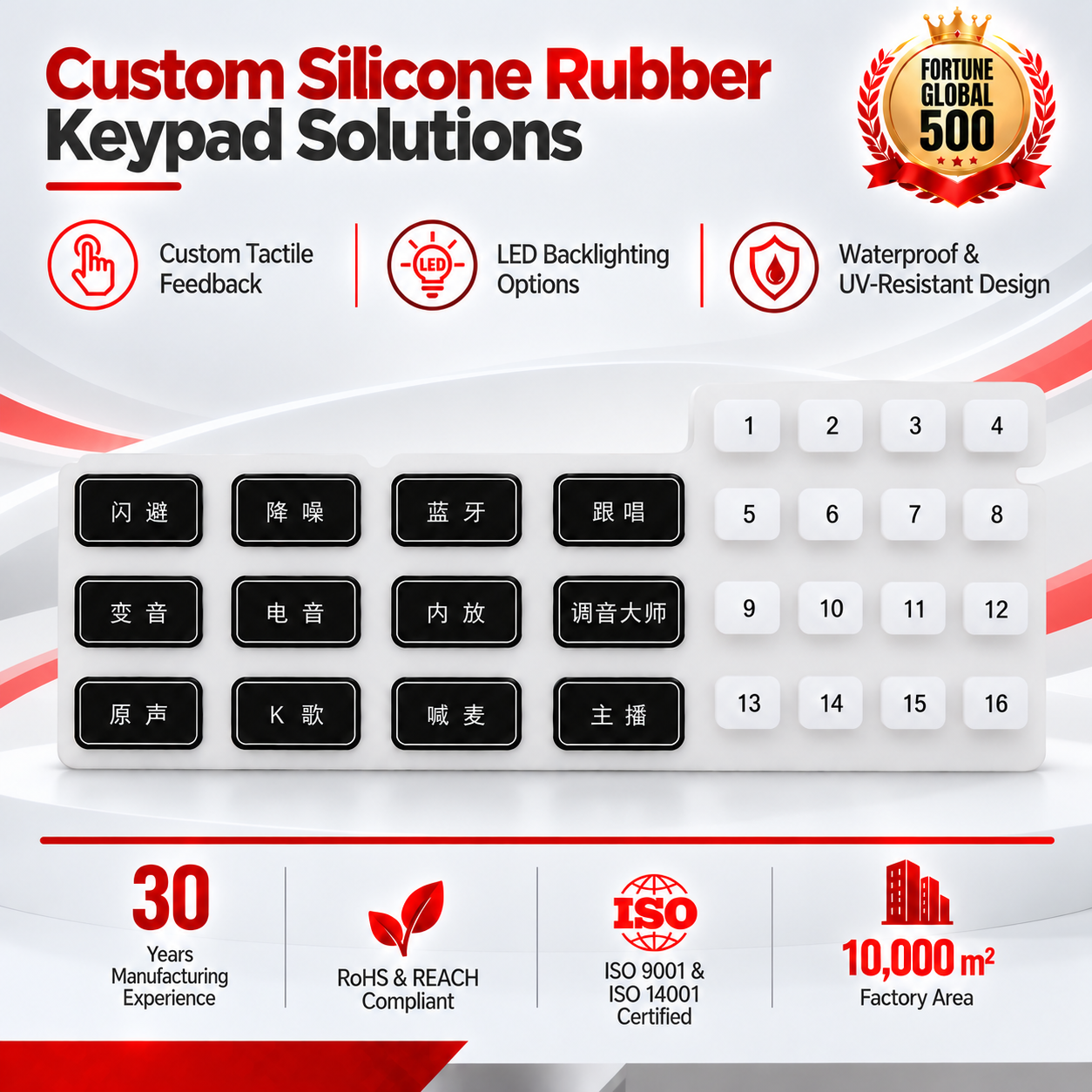
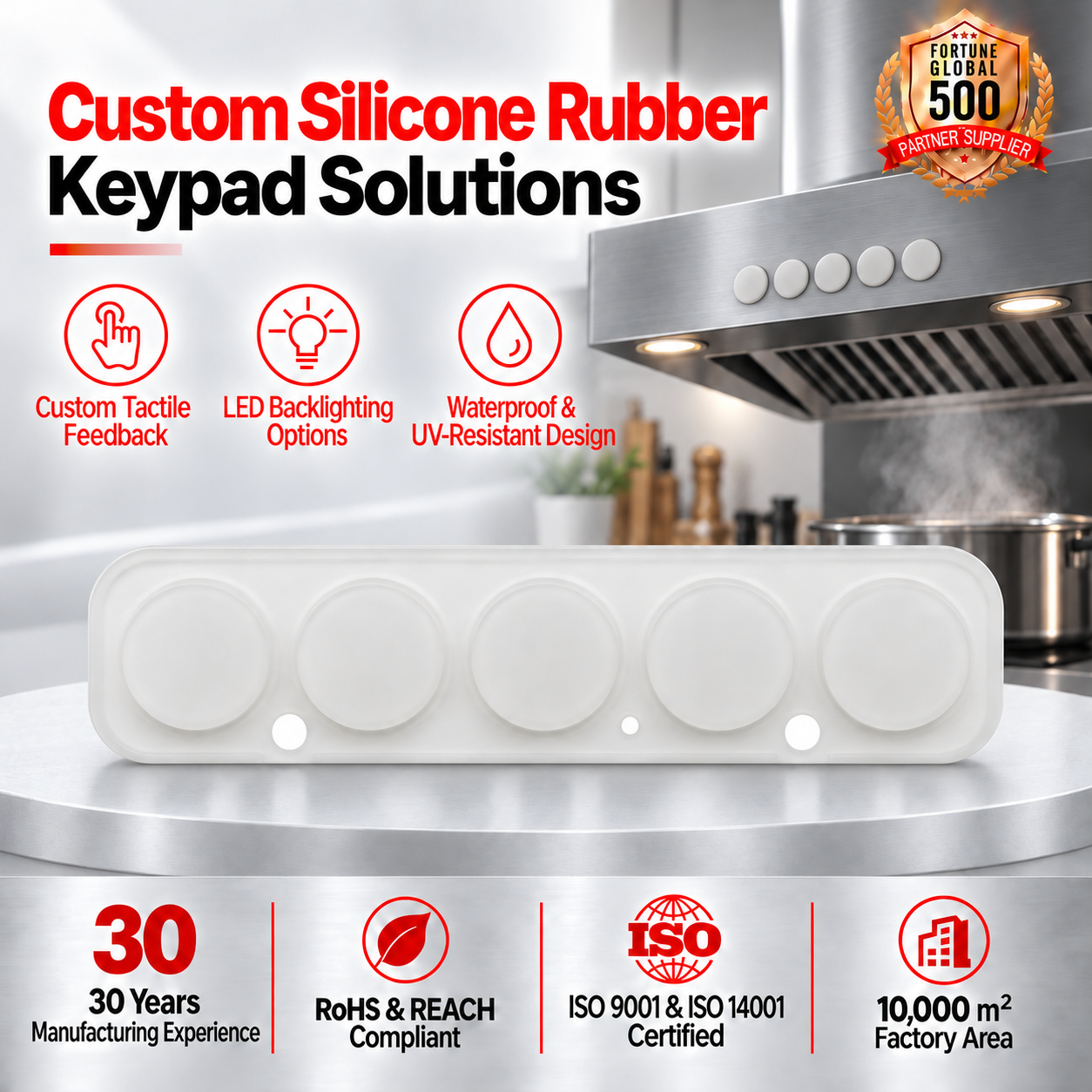
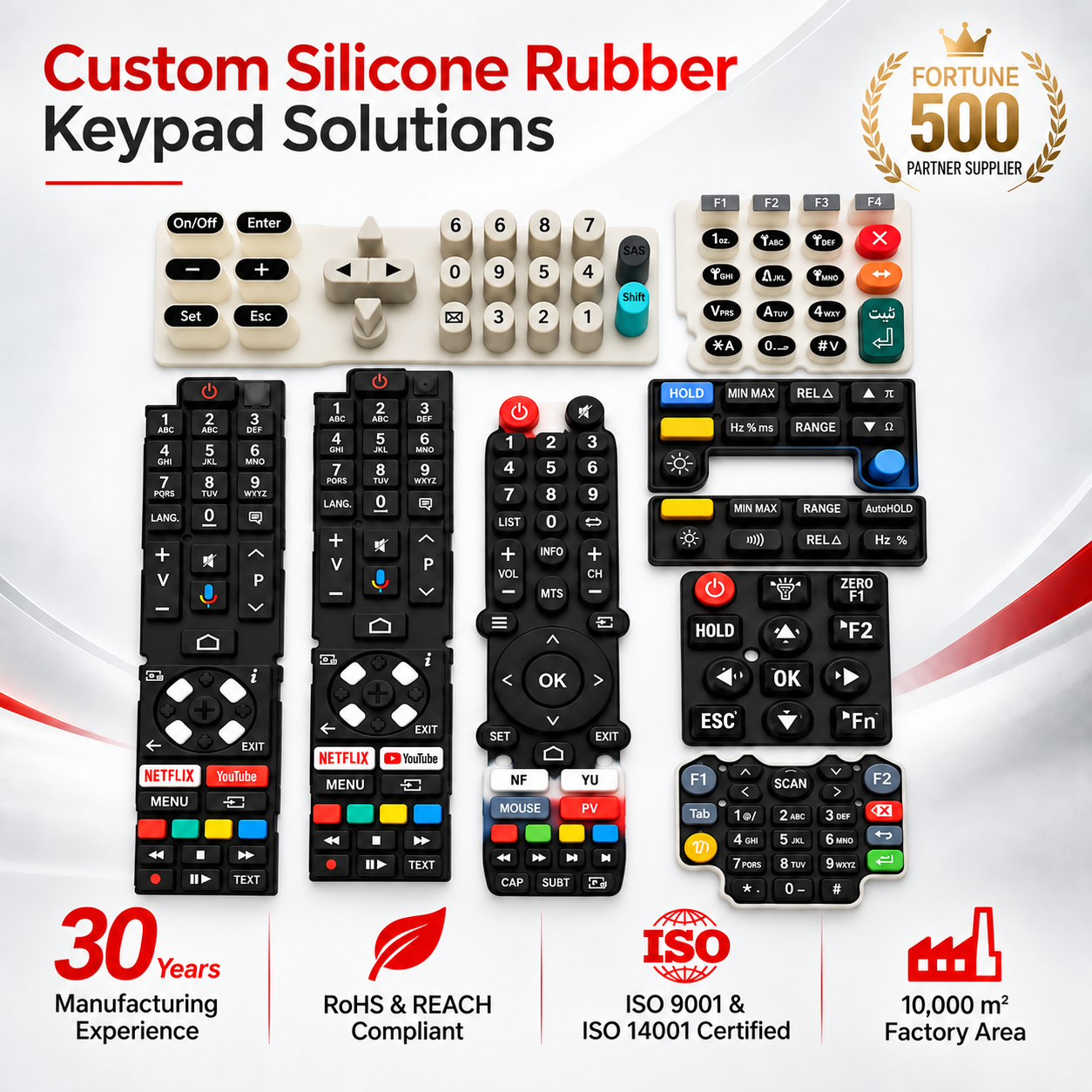
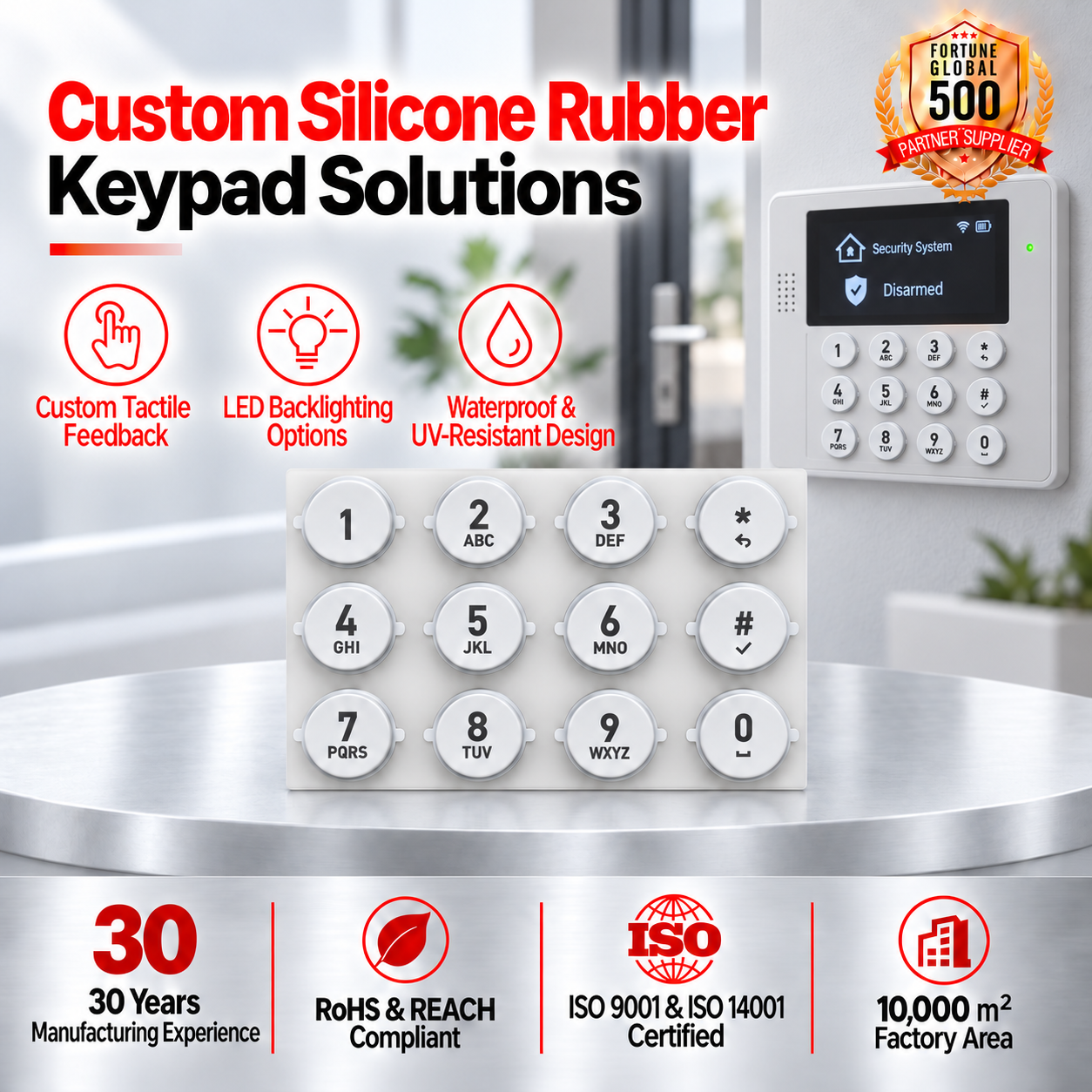
Rugged Waterproofing Custom Silicone Rubber Keypad Numpad Soft Touch Wear-Resistant High Temp Elastomer Keypad
- Ingress Protection: IP67 Immersion
- Key Tactility: Elastomeric Web
- Substrate Match: Capacitive / FPC
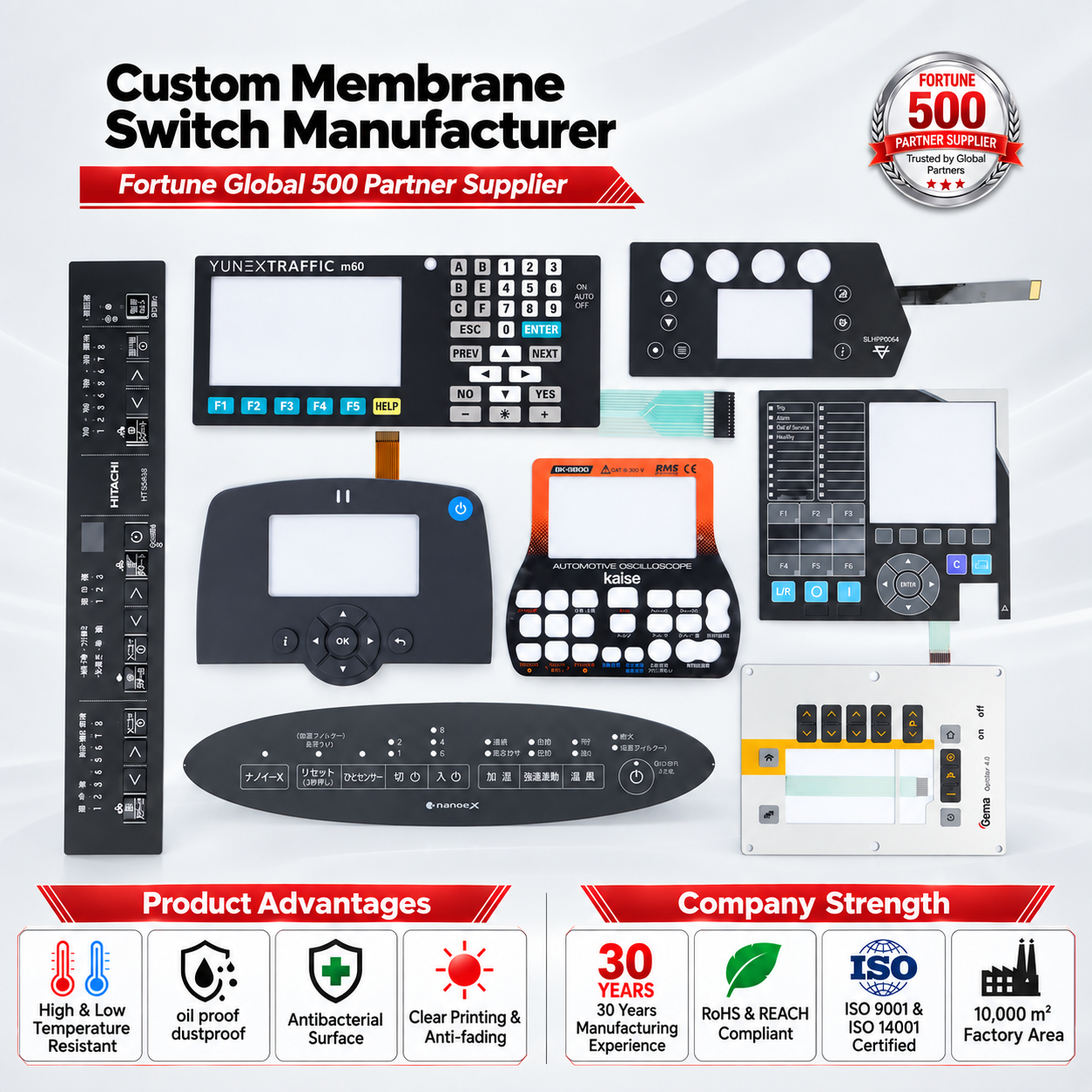
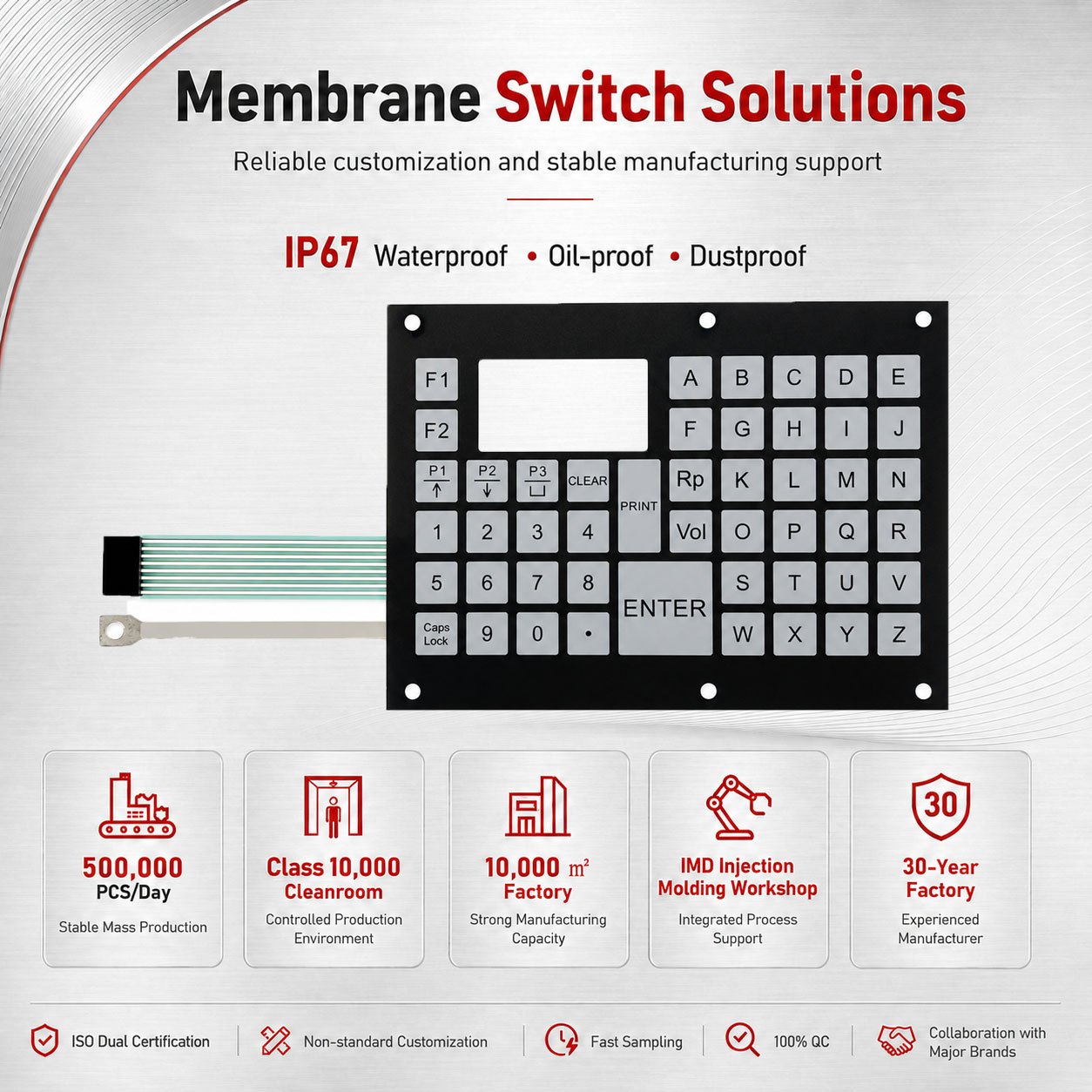
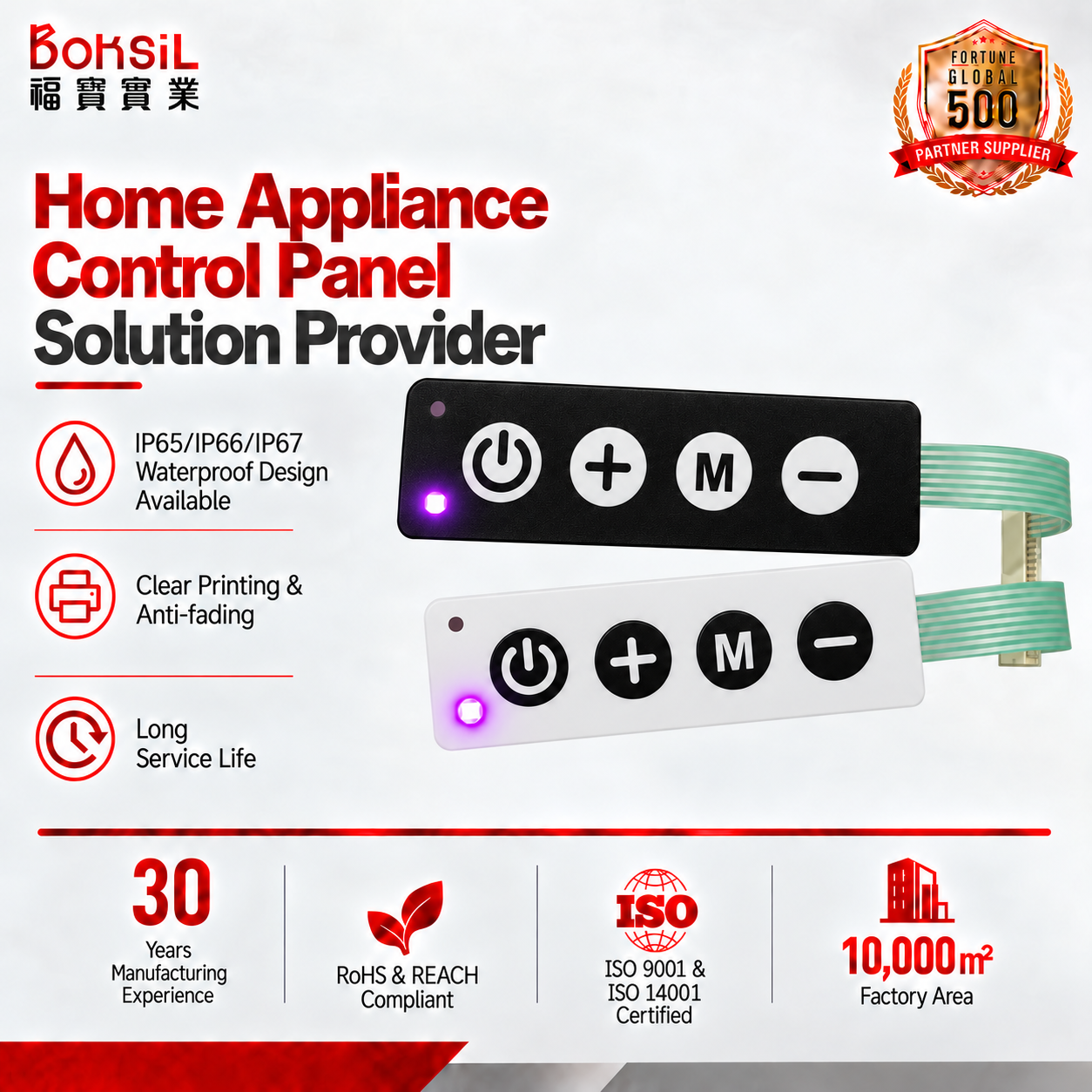
Examine our eight core technical product lines, deployed globally across mission-critical medical diagnostics, rugged off-highway equipment, smart appliances, and industrial HMIs.
Modern capacitive touch switches operate by monitoring dielectric changes in continuous electrical fields. Explore how advanced physical layer design solves real-world industrial noise and environmental issues.
Unlike basic self-capacitance which relies on absolute grounding thresholds, mutual capacitance matrices monitor the intersected node cross-coupling across X and Y drive lines. This isolates individual key actuations, eliminates ghost keying, and operates flawlessly through thick PMMA, tempered glass, or composite overlays up to 10mm thick without compromising actuation latency.
Industrial machinery generates massive RF bursts, motor surges, and conducted noise. Our engineering utilizes differential driven shields and dynamic autocalibration microcontrollers. By deploying driven ground planes around sensor pads, water splashes and cleaning fluids are treated as common-mode noise, eliminating erroneous triggers in wet food-processing or clinical surgical environments.
Selecting the optimal conductor depends on your environment. Screen-printed silver nanoparticle ink on heat-stabilized polyester (PET) delivers exceptional cost-efficiency for large surface interfaces. Conversely, rolled annealed copper on Polyimide (FPC) accommodates ultra-dense routing, direct fine-pitch SMT component assembly (LEDs, controllers, resistors), and provides extreme thermal survival from -40°C to +105°C.
Direct parameter comparison to assist hardware architects and procurement managers in specifying the ideal HMI technology stack.
| Technology Type | Primary Substrate | Actuation Lifecycle | Environmental Seal | Cost Profile | Ideal Applications |
|---|---|---|---|---|---|
| Solid-State Capacitive | Copper FPC / Polyimide | >50 Million Cycles | IP68 / IP69K Hermetic | Moderate to High | Medical diagnostic consoles, white goods, cleanrooms |
| Metal Dome Membrane | Silver Printed PET | 1 - 5 Million Cycles | IP65 - IP67 Sealed | Economical | Industrial controllers, test equipment, commercial HVAC |
| Silicone Rubber (P+R) | Compression Silicone / FPC | 1 - 3 Million Cycles | Gasketed Ingress Proof | Moderate | Handheld diagnostics, military telematics, rugged remotes |
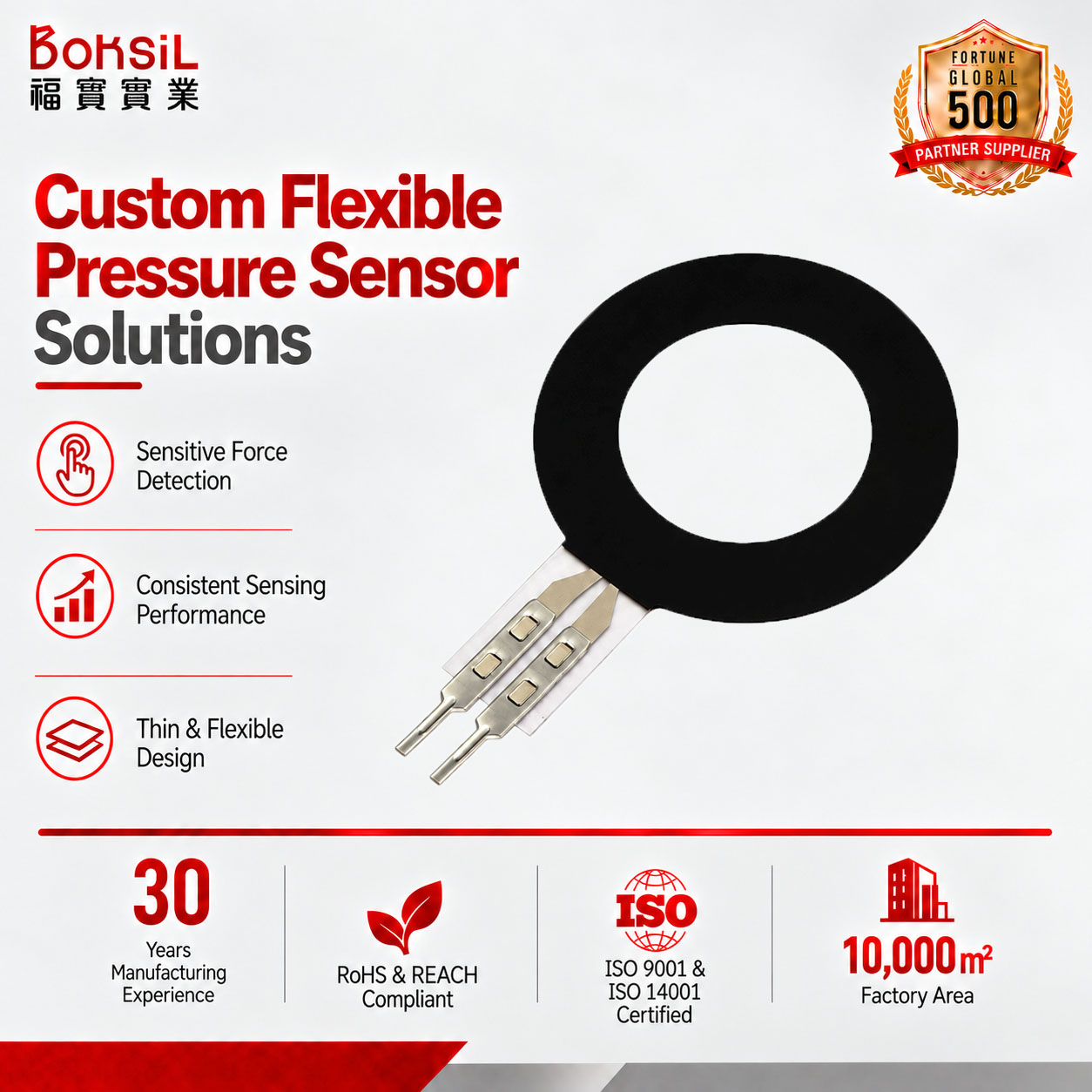
| Hybrid FSR + Capacitive | Force Resistor + Copper Tail | >10 Million Cycles | IP67 Sealed Perimeter | Engineered Tier | Dual-stage safety critical switches, robotics, avionics |
Anticipate supply chain evolutions, cost-optimization curves, and regulatory mandates shaping the high-precision human-machine interface landscape through 2030.
Global procurement teams are transitioning away from discrete multi-vendor sourcing where overlays, metal domes, and printed circuits are bought separately. Fragmented sourcing results in stack-up mismatch and warranty disputes. Sourcing integrated capacitive sub-assemblies directly from specialized Chinese factories compresses assembly times by 30% and localizes QA accountability under a single warranty.
Export compliance requires rigorous chemical alignment with RoHS 3, REACH, and California Proposition 65. Capacitive assemblies are engineered with halogen-free flame-retardant polyimides, lead-free low-temperature solder pastes, and aqueous-developed screen printing inks to streamline carbon border compliance without compromising adhesive shear-strength.
The primary critique of capacitive touch is the absence of tactile feedback. The latest generation combines localized Piezo-electric or Linear Resonant Actuators (LRA) directly laminated behind capacitive film arrays. This delivers crisp mechanical click sensations upon finger detection, resolving operator confirmation needs in high-vibration automotive and surgical settings.
Headquartered in Dongguan, our verified 10,000㎡ production facility bridges cleanroom engineering with rigorous Western export-grade quality governance.
Our 10,000㎡ plant and 121-person precision workforce operate under strict Intertek verified systems, ensuring documented end-to-end traceability for Fortune 500 supply chains.
Equipped with computerized force-displacement testers, key life cyclers, programmable temperature/humidity chambers, ink abrasion testers, and UV yellowing resistance systems.
Dedicated sample lines support pilot production runs from 100 pieces up to full-scale containerized rollouts, supported by bilingual senior DFM engineers assigned directly to your project.
A proven global fulfillment record spanning Europe, North America, and APAC. Export shipments feature antistatic and moisture-barrier packaging with complete FAI inspection dossiers.
Detailed technical answers addressing layer stack-ups, design rules, connector pitch, and durability validations.
Send your drawings, CAD layouts, or project concepts to our Dongguan engineering team. Receive comprehensive DFM reviews, stack-up recommendations, and direct factory pricing within one business day.