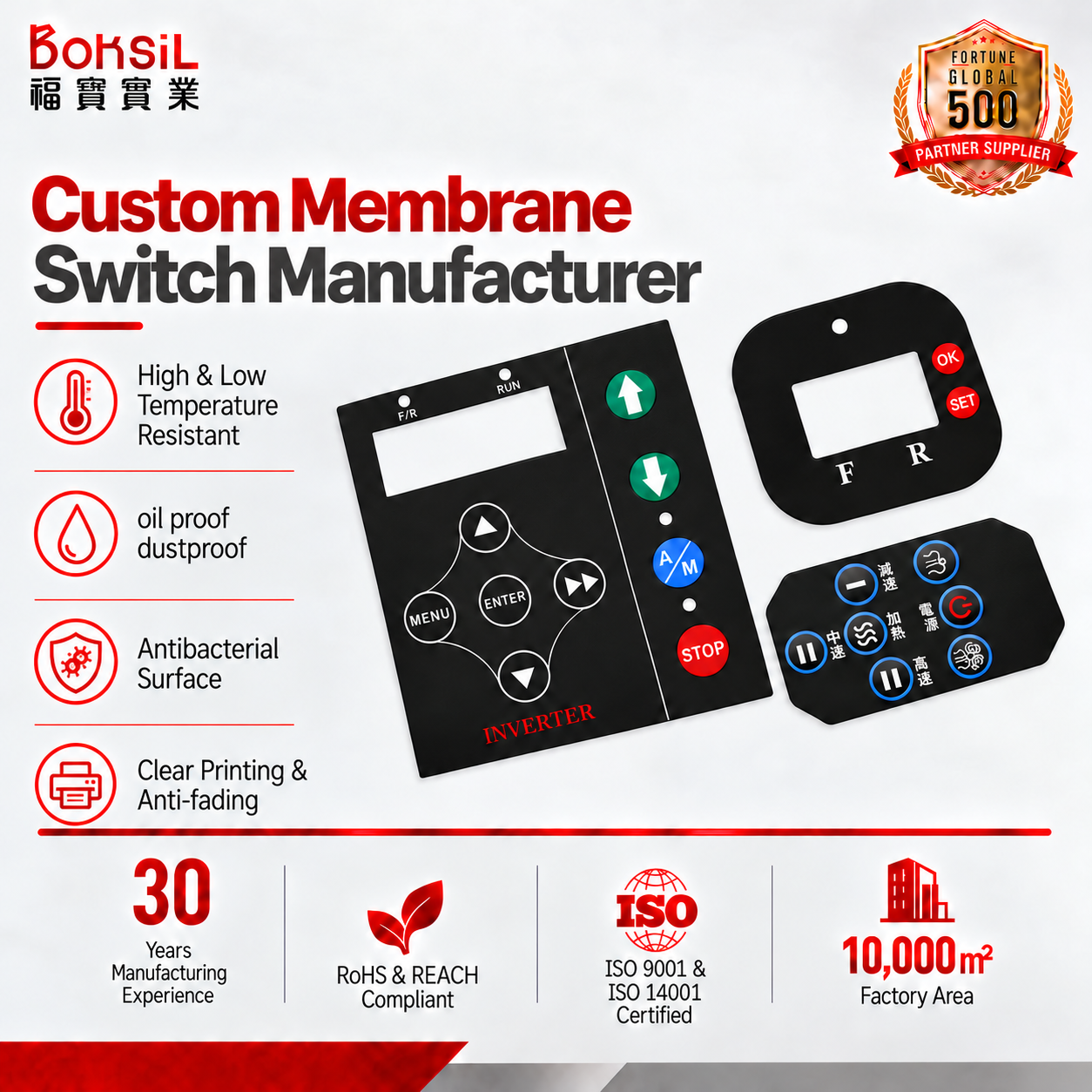
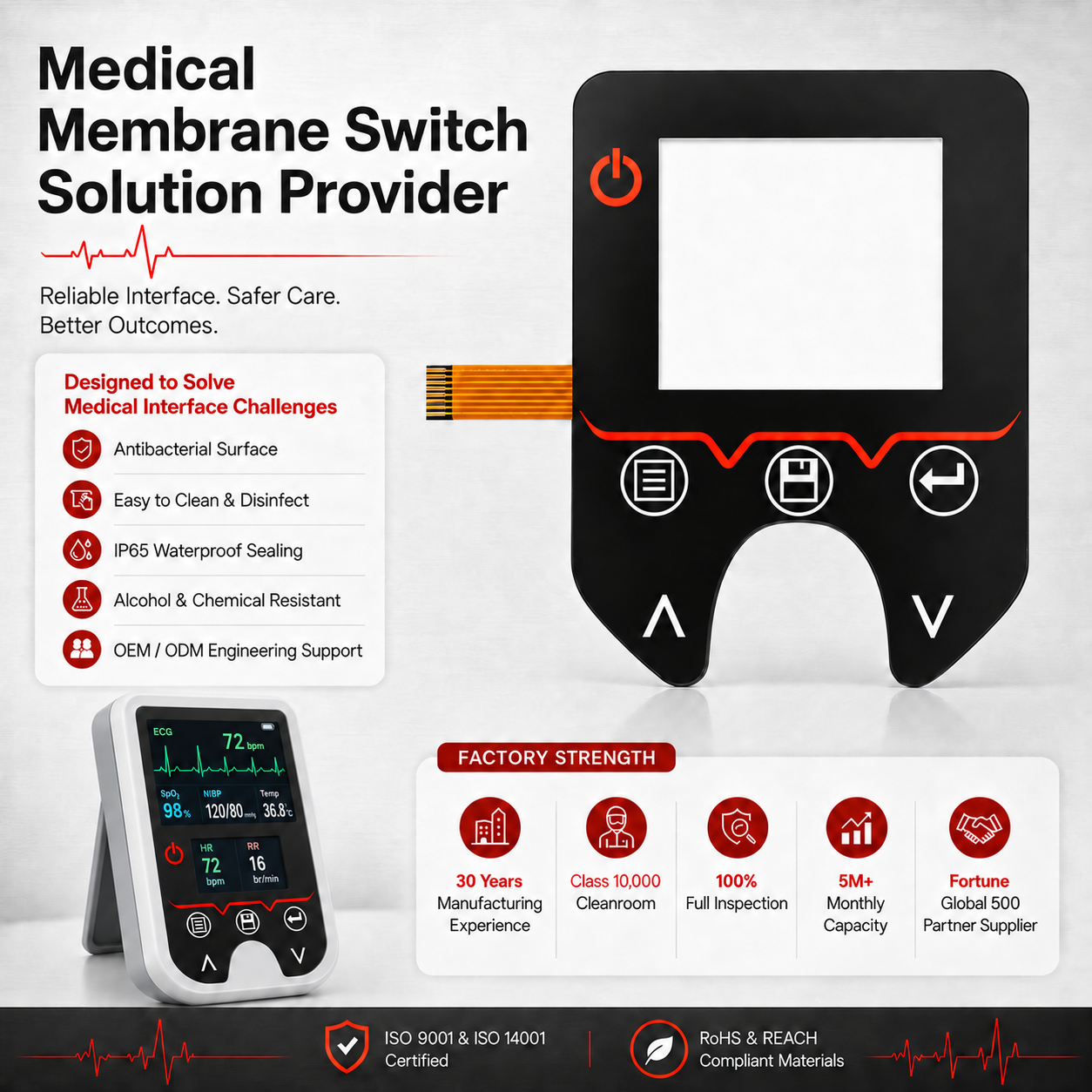
Medical Equipment IP65 Waterproof PC Graphic Overlay Switch
- Substrate: Autotype PET / Lexan PC
- Sealing Class: Full Perimeter IP65 Gasket
- Tactile Feedback: Stainless Metal Dome
- Circuit Layer: Silver Ink / Copper FPC
Every industrial control module is built to rigorous European Conformity (CE) safety, EMC, and environmental durability directives. Backed by 100% automated electrical continuity testing and tailored layer-by-layer stack-up engineering.
Dongguan AXRU Electronics Co., Ltd. operates an on-site Intertek-verified production facility. By integrating Class 10,000 cleanroom screen printing, precision CNC laser plotting, surface mounting, and in-house environmental reliability testing, we eliminate supply chain bottlenecks and guarantee deterministic delivery cycles.
Serving multinational Fortune 500 equipment manufacturers, every production batch adheres strictly to the Low Voltage Directive (LVD 2014/35/EU), Electromagnetic Compatibility (EMC 2014/30/EU), and ISO 9001:2015 traceability frameworks.
Equipped with programmable temperature-humidity chambers (-40°C to +125°C), computerized force-displacement curve plotters, Martindale ink abrasion testers, and UV accelerated weathering stations to certify zero field failure.
Communicate directly with bilingual HMI application engineers. We perform complete Design For Manufacturability (DFM) reviews on your 2D/3D schematics within 24 hours, dispatching fully functional prototypes in as few as 5 to 7 business days.
As industrial IoT architectures and smart factory standards accelerate across European and North American industrial hubs, human-machine interface components are transitioning from commoditized passive switches into highly integrated mechatronic sub-assemblies.
OEM procurement divisions are progressively shifting away from sourcing discrete components (graphic overlays, metal domes, FPC tails, backer plates, and enclosures) from fragmented vendors. Sourcing completely assembled and pre-tested front panel sub-units from a single manufacturer decreases handling damage, pinpoints quality accountability, and slashes total cost of acquisition (TCO) by up to 28%.
While polycarbonate (PC) remains economical for benign indoor interfaces, procurement criteria for outdoor controllers, industrial dishwashers, and CNC machinery overwhelmingly specify biaxially-oriented, hard-coated Polyethylene Terephthalate (PET) films (such as MacDermid Autotype). Hard-coated PET exhibits superior flexural fatigue resistance (>5 million flexes vs. 50,000 for PC) and resists micro-cracking caused by aggressive hydrocarbons, industrial degreasers, and automated clean-in-place (CIP) chemicals.
In mission-critical controllers subjected to prolonged high-humidity and elevated current requirements (driving multi-segment LED backlights or capacitive touch lines), migration from conductive polymer silver flake ink to polyimide Copper Flexible Printed Circuits (FPC) is surging. Copper FPCs eliminate electro-chemical silver migration risks, support tighter pitch connectors (down to 0.5mm), and tolerate direct SMT reflow soldering of active IC drivers.
The intersection of microelectronics, optical thin-film engineering, and industrial ergonomics is redefining how human operators interact with heavy industrial equipment and medical hardware.
Conventional point-source LED backlighting often yields unappealing hot spots and uneven legend illumination. Advanced industrial switches integrate ultra-thin Light Guide Film (LGF) layers (0.125mm to 0.25mm) embossed with proprietary micro-prismatic dot matrix arrays. Driven by side-firing edge LEDs, LGF routes photons evenly across complex keyboard layouts with minimal light leakage and negligible stack-up thickness increase.
Modern smart equipment demands the sleek aesthetic of smartphone capacitive touch screens, yet factory workers operating in oily environments with heavy industrial gloves require definite tactile confirmation. Next-generation HMI panels integrate a hybrid structure: solid-state capacitive sliders or proximity wake-up loops on the outer perimeter, combined with high-snap-ratio (40%-60%) stainless steel tactile domes on primary critical actuators.
With the proliferation of wireless protocols (5G, Wi-Fi 6E, LoRaWAN) on industrial plant floors, switch panels must not act as electromagnetic antennas. We engineer continuous perimeter ground loops and incorporate vacuum-deposited aluminum foils, copper meshes, or selective solid-carbon grid layers within the membrane sandwich, dissipating electrostatic discharges up to 15kV without microcontroller latch-up.
Evaluate fundamental electro-mechanical performance criteria to select the optimal switch topology for your application's operating envelope, target lifetime, and tooling budget.
| Technology Topology | Typical Stack Construction | Actuation Life (Cycles) | Ingress Rating (IP) | Tactile Sensory Feel | Tooling & Setup Cost | Best Fit Industry Segment |
|---|---|---|---|---|---|---|
| Tactile Metal Dome Membrane Switch | PET Overlay + Spacer + Stainless Domes + Silver/PET Circuit | 1,000,000 to 5,000,000 | IP65 / IP67 Sealed | Crisp, audible snap click (250g - 450g) | Moderate (Steel die / Silk screens) | Medical diagnostic machines, industrial PLCs, lab test gear |
| Copper FPC Membrane Switch | Textured Polyester + Polyimide Copper Circuit + Metal Domes | 3,000,000 to 5,000,000+ | IP67 Sealed | Precise, consistent tactile feedback | Moderate to High (Photolithography tooling) | Defense electronics, aerospace cockpits, rugged handhelds |
| Silicone Rubber Elastomer Keypad | Compression-molded silicone rubber with conductive carbon pills | 500,000 to 2,000,000 | IP65 (With perimeter compression bead) | Soft, cushioned stroke with high travel (1.0-2.5mm) | High (Hardened steel compression molds) | Surveying devices, heavy machinery remotes, barcode scanners |
| Capacitive Touch Glass / Film Panel | Chemically tempered glass or acrylic + ITO / PEDOT sensing electrodes | Virtually Unlimited (Zero mechanical wear) | IP68 Continuous | Smooth glass touch; requires haptic vibration motor | High (Optical bonding + Sensor artwork) | Commercial food processing, sterile operating rooms, smart home |
| Vandal-Resistant Stainless Steel Keypad | Machined SUS304/SUS316 faceplate + internal micro-switch or dome PCB | 5,000,000+ | IP65 / IK10 Impact | Short travel metallic stop | High (CNC milling & stamping dies) | Fuel dispensers, public ticketing kiosks, access security panels |
Critical answers to common technical queries encountered during DFM reviews, vendor qualification audits, and project commissioning.
CE certification on membrane switches primarily addresses the Low Voltage Directive (LVD 2014/35/EU) for creepage and dielectric breakdown under operational voltages, RoHS Directive (2011/65/EU and amendment 2015/863) restricting hazardous heavy metals and phthalates, and EMC Directive (2014/30/EU). AXRU guarantees compliance by utilizing UL94-rated flame-retardant substrate films, fully documented SGS test reports for all inks and adhesives, and integrated continuous Faraday cage grounding loops to prevent EMI emissions.
Silver migration occurs when moisture combines with DC voltage potential, causing dendrites to grow between adjacent conductive traces and triggering electrical shorts. We prevent this by maintaining strict trace spacing design rules (>0.75mm pitch), overcoating all conductive silver traces with a pinhole-free dielectric barrier layer, and deploying moisture-impervious perimeter adhesive gaskets (e.g., 3M 200MP/300LSE acrylic series). For extreme condensing environments, we recommend transitioning to our polyimide Copper FPC circuit topologies.
Standard membrane switches feature open vent channels behind metal domes to equalize air pressure during button actuation. For IP65 and IP67 ratings, we implement an isolated internal labyrinth venting system that recirculates trapped air into sealed dummy chambers without opening to the external atmosphere. Combined with unbroken perimeter die-cut adhesive borders and waterproof tail exit boots, this seals the assembly against wash-down jets and complete temporary submersion.
To initiate an engineering review and quotation within 24 hours, our engineering office requires: (1) 2D vector artwork (Adobe Illustrator .AI, CorelDraw, or PDF) detailing graphic layers and Pantone/RAL color codes; (2) Mechanical CAD drawings (.DXF, .DWG, or 3D .STEP) showing cutout locations, tail length, and overall tolerances; (3) Schematic circuit diagram specifying matrix connections or common-bus pinouts, LED colors, and connector pitch (e.g., 2.54mm or 1.0mm ZIF); and (4) Operating environmental specifications.
Tactile feel is dictated by the dome's actuation force and "snap ratio" [(Actuation Force - Return Force) / Actuation Force]. For bare-finger consumer operation, a light actuation force of 200g-250g with a 40% snap ratio provides gentle feedback. However, for industrial plant or field settings where operators wear thick nitrile or leather work gloves, we specify oversized stainless steel domes (16mm to 20mm diameter) engineered for 350g to 500g actuation force and a crisp snap ratio of 50% to 65% to provide clear sensory feedback through the glove.
Every production batch undergoes 100% automated electrical testing for open circuits, short circuits, switch contact resistance (typically <100Ω for silver ink, <1Ω for FPC), and insulation resistance (>100MΩ at 100V DC). Additionally, statistical sampling plans (AQL 0.65 Level II) evaluate actuation life on our automated life-testing rigs (cycling past 1,000,000 actuations), adhesion peel strength testing (ASTM D3330), cross-hatch ink adhesion testing (ASTM D3359), and thermal cycling in our environmental chambers.
Whether you need a full DFM analysis on a new prototype drawing, an urgent drop-in replacement for an obsolete front panel, or a cost-down value engineering review for mass production, our Dongguan engineering lab is ready to assist. Contact our senior technical sales team today.