China has become a significant sourcing base for custom control panels, combining printing, circuit design, die-cutting, and assembly. A Membrane Switch Keypad may look simple, but its layers must work together: printed graphics, tactile domes, adhesive, and a flexible circuit. Poor alignment can make a key feel uneven. Small details matter.
Grand View Research estimated the global membrane switch market at approximately USD 4.7 billion in 2023 and projected a 10.2% compound annual growth rate from 2024 to 2030. These figures suggest continued demand, though market estimates vary by research method and definition. They do not prove that any individual factory is reliable. Buyers still need to assess samples, process controls, and communication.
This guide introduces leading membrane switch keypad manufacturers in China and the capabilities worth comparing. Look beyond a polished website. Ask whether a supplier can provide clear drawings, material specifications, and test results for the intended application. Check how it handles key force, environmental exposure, and production changes. A well-made sample is useful. Consistent batches matter more. No manufacturer fits every project, and supplier claims deserve verification. That part is easy to overlook.
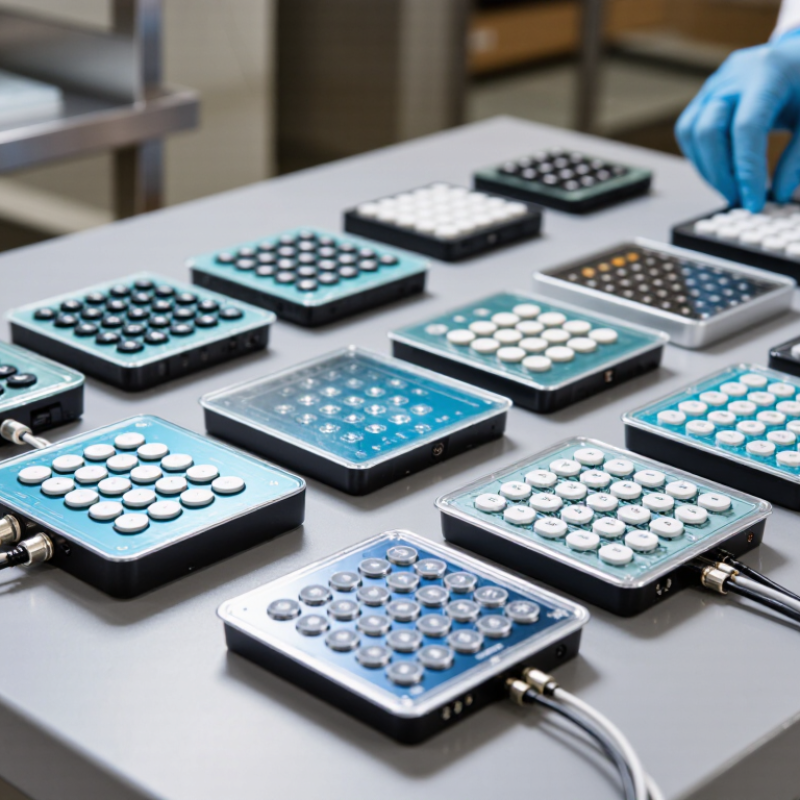
A membrane switch keypad is a thin electromechanical stack, not simply printed plastic. Its visible overlay carries legends and protects the keys from abrasion, moisture, and cleaning agents. Polyester often suits repeated flexing; polycarbonate can provide crisp graphics and a smooth surface. Below the overlay, an adhesive spacer maintains a small gap above the circuit. Pressing a key deflects the layer until conductive contacts meet and close the circuit. Release restores the gap. Small details matter. Spacer thickness, dome geometry, and switch travel influence force and tactile feedback. Screen-printed silver traces carry signals, while carbon contacts can help limit contact wear.
Grand View Research estimated the global membrane switch market at USD 5.17 billion in 2022. Its report forecast a 7.2% compound annual growth rate from 2023 to 2030. That commercial outlook is not a durability test. For China-based sourcing, review stack drawings, adhesive compatibility, and print registration under backlighting. Ask for force-travel curves and cycle-test conditions, not only a headline cycle count. Results depend on humidity, temperature, and how a test defines failure. A keypad can look precise and still feel uneven. That trade-off deserves a real sample review before tooling.
When comparing membrane switch keypad manufacturers in China, ask how they verify a one-million-actuation rating. A cycle count means little without a defined test method. The supplier should state the actuator force, speed, contact point, and electrical failure criteria. Request test records for the exact keypad construction, not just a similar product.
Small details matter. A key pressed repeatedly at its center may last longer than one struck near its edge. Ask whether testing covers the overlay, printed circuit, adhesive layers, and tail connection. One million cycles is a useful benchmark, not a promise of service life in every setting. A lab result is not a field guarantee.
IP67 performance also depends on the assembled keypad and its mounting. Under IEC 60529, the rating describes dust protection and temporary immersion under specified test conditions. Check whether samples were tested after installation, with the intended gasket, enclosure, and cable exit. Look closely at corners and cutouts; these are common sealing weak points. One detail is easy to miss. Repeated cleaning, temperature changes, and worn seals can alter real-world protection, so request clear test conditions and inspect production samples before approval.
China’s leading membrane switch keypad manufacturers can differ sharply in design support, production control, and customization options. A useful comparison starts with the intended environment: a keypad for a damp control panel needs different materials and sealing than one used indoors. Ask how the supplier selects overlay films, adhesive layers, and tactile domes for your operating conditions.
Design details matter. Check whether engineers can review artwork, button spacing, backlighting, and connector placement before tooling begins. Request a physical sample, not only a digital drawing. Small issues show up quickly. A key may feel too stiff, or printed labels may become hard to read under angled light.
Production capability is more than a large factory floor. Ask about inspection at incoming-material, printing, and assembly stages, and how rejected parts are recorded. For customization, clarify options such as embossed keys, transparent windows, shielding, and tail layouts. Then compare the cost and lead time of each change. A supplier may offer broad customization but have limited experience with a particular adhesive or outdoor exposure; this is easy to overlook. Prototype results can also differ from mass production, so ask how sample settings are transferred to production and what tolerances are checked. A clear answer is reassuring.
Comparison guide: This table summarizes common membrane keypad design and production options offered by manufacturers in China. Capabilities vary by supplier and project; it is not a company-specific ranking or an independently audited supplier assessment.
| Comparison Dimension | Design | Production | Customization |
|---|---|---|---|
| Overlay Materials | Designs commonly use polyester (PET) or polycarbonate (PC) film. Material choice depends on the required appearance, flexibility, chemical exposure, and operating environment. | Printed graphics are typically applied to the underside of a transparent overlay to protect the image from surface wear. | Options can include clear or matte finishes, transparent display windows, textured areas, and selective surface treatments. |
| Circuit Construction | Designers can use a flexible printed circuit or a rigid printed circuit, depending on electrical requirements, space, and assembly method. | Flexible circuits commonly use polyester film with printed conductive traces; rigid circuits use a solid circuit-board substrate. | Circuit layout, tail position, connector type, trace routing, and contact-pad arrangement can be adapted to the device. |
| Key Feel and Switching | Key response can be designed as non-tactile or tactile. Tactile designs may use formed metal domes or embossed layers. | Switch layers are aligned and laminated so that pressing a key closes the intended electrical contact. | Key shape, spacing, actuation feel, embossing style, and dome arrangement can be specified for the application. |
| Graphic and Labeling | Artwork planning accounts for key legends, viewing windows, indicator locations, and the overlay’s print layers. | Screen printing and digital printing are commonly used, with the process selected according to artwork and production needs. | Custom colors, legends, symbols, logos, and window openings can be incorporated from approved artwork. |
| Backlighting and Indicators | Backlighting design must consider light distribution, display windows, component placement, and the keypad’s layer stack. | Possible solutions include LEDs, light guides, or electroluminescent lighting, subject to the product’s electrical and mechanical design. | Lighting color, illuminated key areas, indicator positions, and window dimensions can be tailored to the user interface. |
| Sealing and Adhesive | Sealing design depends on the enclosure interface, exposed edges, cable exit, and the environment in which the keypad will be used. | Pressure-sensitive adhesive layers are commonly used to attach the keypad to a mounting surface. | Adhesive type, thickness, outline, cutouts, and sealing details can be specified. Any ingress-protection rating should be verified for the finished assembly. |
| Mechanical Integration | Design reviews typically cover panel dimensions, key pitch, mounting area, bend radius, and clearance for the circuit tail. | Die-cutting and layer registration are used to produce the overlay, spacer, circuit, and adhesive shapes. | Custom outlines, mounting holes, cutouts, tail orientation, and connection details can be matched to the host product. |
| Quality Checks | Inspection criteria can be defined for artwork, dimensions, key positions, and visible surface defects. | Typical checks include visual inspection, dimensional verification, and electrical continuity or switch-function testing. | Acceptance criteria and test plans can be agreed for project-specific electrical, mechanical, and appearance requirements. |
| Prototyping and Production Readiness | Prototype review helps confirm artwork, fit, key feel, and electrical interface before production tooling is finalized. | Production planning depends on the design, tooling requirements, materials, order quantity, and inspection plan. | Sample quantities, revision control, packaging, and production documentation can be discussed with the supplier before order approval. |
Top Membrane Switch Keypad Manufacturers in China
Quality and Compliance: ISO 9001, RoHS, and IEC 60529 Ratings
For membrane switch keypads, compliance is only useful when it matches the finished product and its working environment. ISO 9001:2015 describes a quality management system, not a product-level performance guarantee. The ISO Survey 2022 counted 1,265,216 valid ISO 9001 certificates across 189 countries and economies. That scale shows how widely the system is used, but a certificate alone cannot confirm consistent keypad quality. Ask for current certification scope, inspection records, and traceability from material batches to finished units.
RoHS documentation should identify the applicable restricted substances and support claims with supplier declarations or test evidence. For IEC 60529, check the stated IP rating and confirm what was tested: the keypad alone, or the complete assembled enclosure. A keypad’s edge seal may look neat under bright factory lights, yet dust or moisture can still enter around a cable exit or mounting cutout. The installation matters.
Small details matter. Before approving a sample, compare its label, drawings, and test reports; check that the tested configuration matches your order. I would not treat a high IP rating as a promise under every condition. Cable routing, adhesives, operating temperature, and repeated cleaning can change real-world performance. That caveat is easy to overlook.
How to read this chart: IEC 60529 IP codes use a first digit for protection against solid particles and a second digit for water ingress; higher digits indicate greater protection within each category. These examples illustrate rating levels, not manufacturer rankings. For membrane keypads, verify the exact tested assembly and application requirements. ISO 9001 concerns quality management systems, while RoHS restricts certain hazardous substances in electrical and electronic equipment.
A supplier’s minimum order quantity should fit your launch plan, not just its production line. Ask whether the MOQ applies to each graphic design, circuit layout, or total order. For a pilot run, clarify setup charges and whether later batches can use the same tooling. Small details matter. A sample with your actual overlay, connector, and adhesive can reveal fit problems before volume production.
Lead time needs a clear starting point. Does the schedule begin after artwork approval, sample sign-off, or deposit? Request separate estimates for prototypes and repeat orders, and ask what could delay shipment. A few days of buffer is sensible. It may still be too little if a custom material is involved.
Testing should match the keypad’s real use. Discuss electrical continuity, key response, adhesive bonding, and resistance to expected heat or moisture. Ask for test criteria and recorded results, rather than accepting “quality checked” as proof. After-sales support also deserves specifics: who handles reported defects, what evidence is needed, and how quickly replacement parts can be arranged? I would put these points in the order documents. Some issues only appear after installation, so a perfect sample is not a guarantee.
A typical keypad has a protective overlay, an adhesive spacer, and a printed circuit layer. Pressing a key closes the small gap between conductive contacts.
Polyester often handles repeated flexing well. Polycarbonate can provide crisp graphics and a smooth surface. The right choice depends on use conditions.
The key presses through the overlay and deflects the layer below. Conductive contacts meet, closing the circuit. Releasing the key restores the gap.
Spacer thickness, dome shape, and switch travel all affect how a key feels. Small details matter. A drawing cannot show every uneven press.
Test the actual overlay, connector, and adhesive. Check key feel, label readability under angled light, and backlighting. A digital drawing is not enough.
Ask for electrical continuity, key-response, adhesive-bonding, and relevant heat or moisture test results. Request test criteria and conditions, not just a cycle count.
Confirm whether the minimum applies to each design, circuit layout, or total order. Ask when lead time begins and request separate estimates for prototypes and repeat orders.
No. Prototype results can differ from mass production. Ask how sample settings transfer to production and which tolerances are checked. Even a perfect sample is not a guarantee.
A Membrane Switch Keypad is built from layered films, conductive circuits, spacers, and graphic overlays. Its materials and carefully designed contact points allow a press to complete an electrical circuit and register an input. When comparing manufacturers in China, buyers can assess design expertise, production capacity, customization options, and experience with different applications. Performance benchmarks such as one million actuations and IP67 ingress protection can help define requirements, but they should be confirmed through product specifications and suitable testing.
Quality evaluation should also consider documented processes and relevant standards, including ISO 9001, RoHS requirements, and IEC 60529 ingress protection ratings. Before choosing a supplier, clarify minimum order quantity, lead time, sample availability, testing procedures, and after-sales support. Comparing these factors alongside communication and technical responsiveness can help buyers select a keypad solution that fits their operating environment and project needs.